Just a quick post to share some results from my latest pottery experiment in my little gas kiln…
I have wanted a wood-burning kiln for years, in order to get the runny, natural ash effects that I really love.
If you don’t know, in a long, hot wood firing, the ashes from the burning logs rain down on the pots, melt into a glaze, and form green/brown/gold layers and long drips down the pots, often with crystals if slow cooled.
Where I live, though, I have close neighbours with young children and I don’t feel I can be pumping out smoke for a day or more 8 metres from their windows.
I have seen potters like Lisa Hammond and David Hooker who sprinkle ash over shino glazes and fire the pots in gas reduction (Lisa soda fires too, for more interesting results). They do get some great effects that look very ‘wood-fired’.
I have previously sprayed ash glaze over shino and felt the results were pretty yucky.
So last week, I tried pure dry wood ash. On two bottles that I’d glazed with two different shinos, I heavily sifted mixed hardwood ash over the top. Sorry, I forgot to take photos. But you want a good few millimetres.
David Hooker applies the ash when the glaze is wet, so it will adhere. I had let mine dry, so I moistened the bottles with a spray of soda ash solution and then sprinkled on the ash through a metal sieve.
It actually stuck well and the ash didn’t fall off when the pots were moved. One has to be careful when handling them not to rub off the ash.
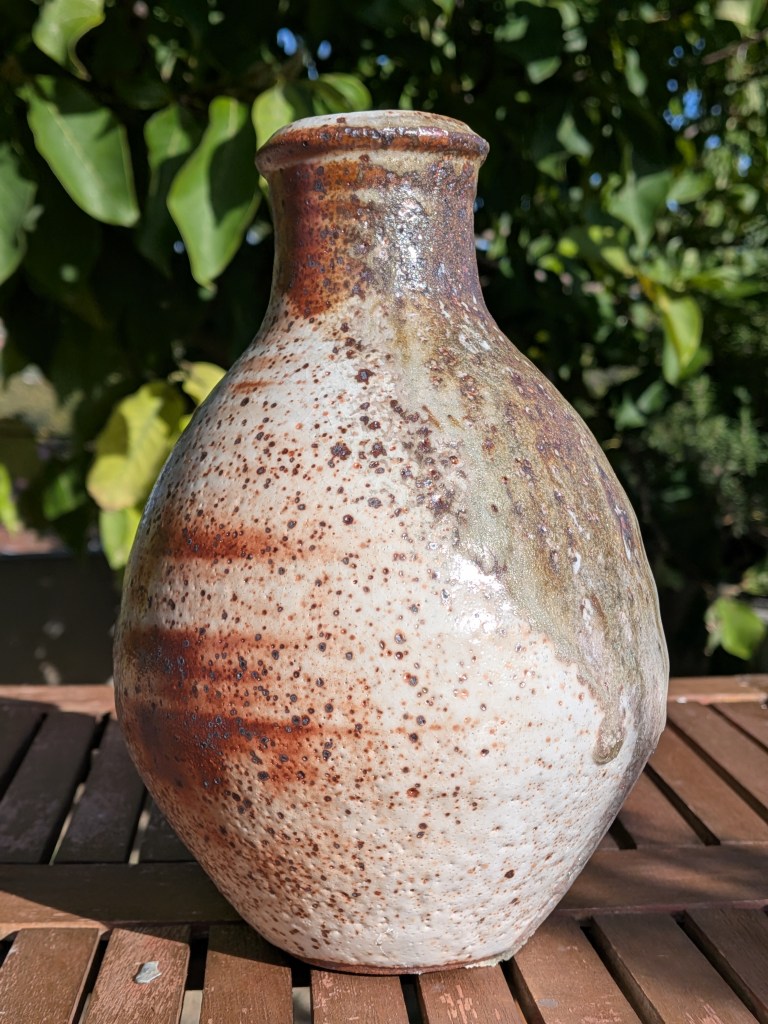
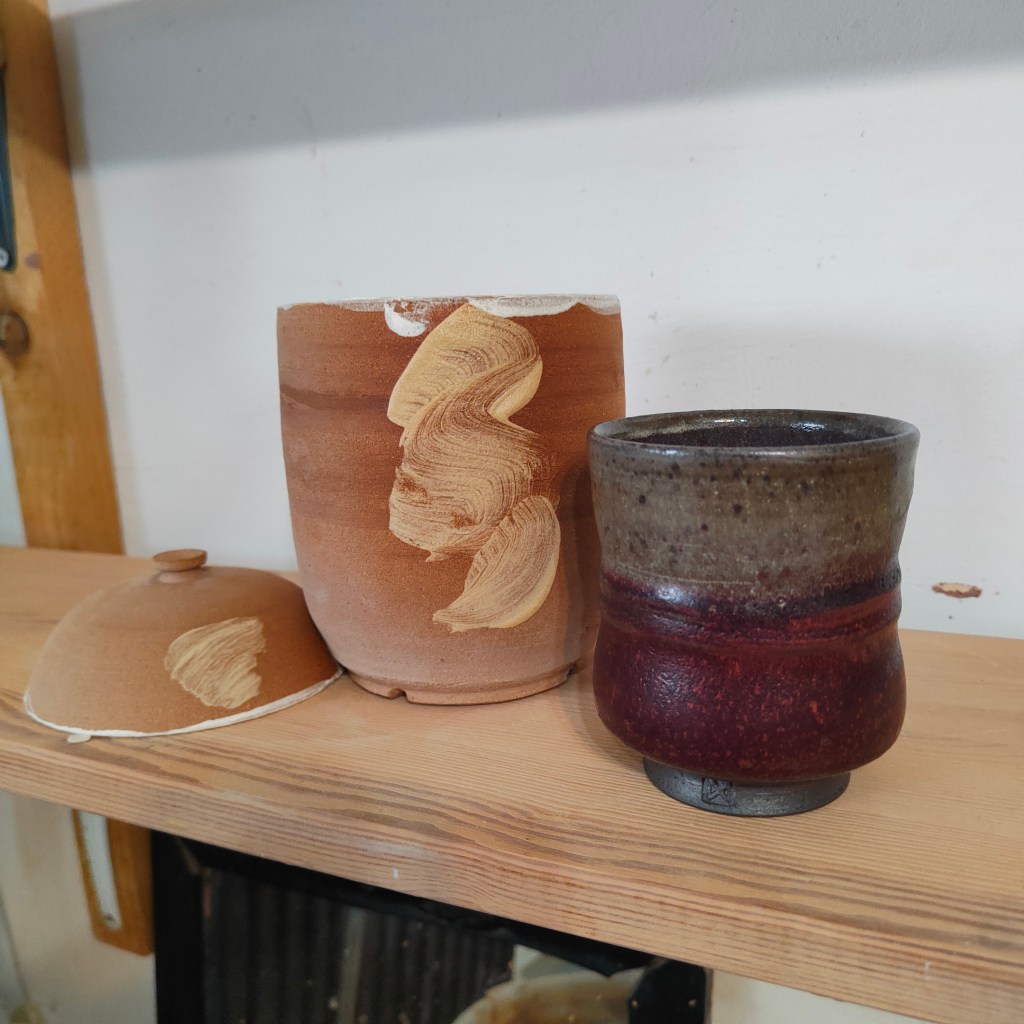
On brown stoneware clay with Al’s shino glaze
So, on to the results. I placed the two pots in the hottest part of my kiln (hits cone 10-11) and fired in reduction: heavy initially and then light till the cones were down, with a little heavy reduction soak for the last 15 minutes.
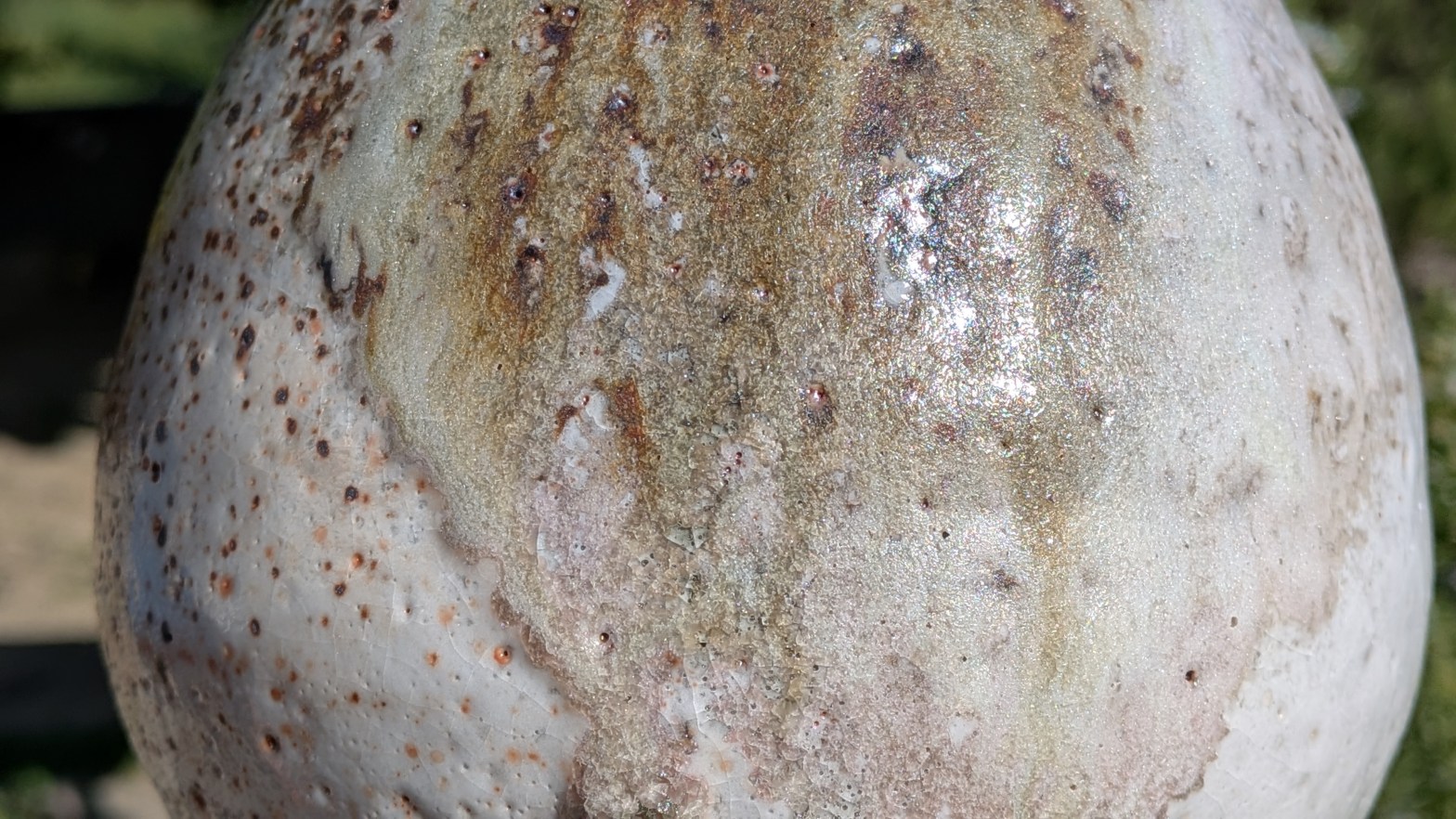
The final effects were, I would say, very like you’d achieve in a wood firing. Thick ash zones with runs down the pot. I think one would get a more interesting look to fire the pots on their sides, having put the ash on the top side, so the ash runs would go around the pot. I will this try next time.
It’s worth putting the pots on stilts, shells or wadding as the ash runs may drop off the foot of the pot.
I used two types of clay: a groggy black one and a red-brown stoneware. The ash came out much darker on the black clay pot, and more of the green I expected on the red clay one. But the shino recipes were different, and the darker aka shino was a bit thinner than the other formula (Al’s shino), so it’s hard to say what caused the difference. A combination of these factors, I’d guess.
On groggy, black clay with aka shino.
Overall, I am pretty happy with the pots that arose from this new-for-me technique.
What you won’t get in the gas kiln compared to a wood kiln is much/any of the flashing effects on exposed clay. Using different types of ash will likely also change the look of your results. I would love the glassy, bottle green runs some potters get – I think pine wood might give that result.
Next, I plan to side-fire some on shells. I am also thinking about trying this with no glaze on the pot and light sprinkles of ash to get something of a Bizen-style effect. Maybe combined with strands of natural twine soaked in soda ash tied around the pot to give extra decorative flashing effects.
Hopefully these tests will inspire some more posts…
Recently, I have been conducting a few experiments in my electric kiln to try and achieve reduction using lidded containers of clay known as saggars.
I had better preface this post with the warning that, should you try this, there is a risk of damaging your kiln elements due to the reduction gases. So be warned.
However, if the saggar is well sealed so the carbon gases are contained, I figured it is not likely to do any/much harm as an occasional test.
The premise of reduction, put very simply, is that carbon dioxide/monoxide in the kiln atmosphere will rip oxygen molecules from the glaze, thus changing the nature of the metal oxides within it. This will change the colour of the glazes. For example, iron oxide will produce greens or blues instead of tan to brown, while copper will go red/purple instead of green. It can also change the behaviour of a glaze, e.g. iron oxide will flux more in reduction, so watch out for the runs.
Normally one would achieve a reduction firing in a gas or wood kiln by limiting the flow of air through the kiln to produce an inefficient firing and encourage the formation of carbon gases. But it can be done with a saggar by placing combustible materials inside. Charcoal is what I used.
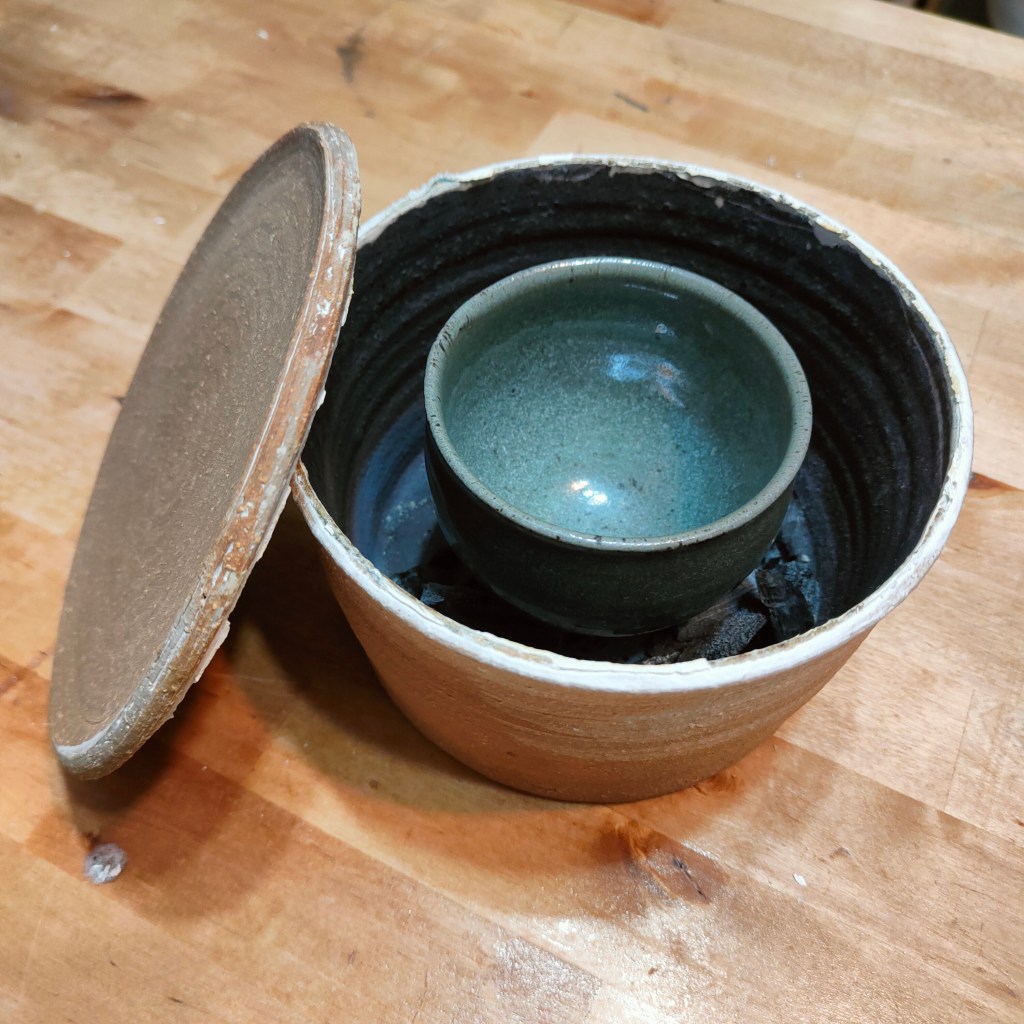
The saggar is simply a lidded clay container that is large enough to hold your glazed pottery with a little space all around. Saggars have been used in pottery for hundreds of years, normally to keep ashes off the wares.
For reduction, the saggar and lid must be sealed together to contain the carbon gases, both to reduce the glazes and to protect the electrical elements.
I have seen a couple of Japanese potters use the saggar method on YouTube and they used a clay ring to seal the lid. I have tried this and found the clay cracks and comes loose, so I do not believe it is a good seal. As an alternative, I tried batt wash – the refractory slip one uses to protect kiln shelves. It needs to be painted on thickish so that there is plenty to make a good seal. This worked a treat and didn’t crack. The lid still popped off very easily after the firing.
A darker green result on my 3rd attempt. Here you see the sagger and some remaining charcoal (it didn’t all burn at cone 6)
The whole process goes:
Throw/construct and bisque fire the saggar and lid (think small casserole dish). Make it big enough to fit the pot(s) you intend to reduction fire, allowing for clay shrinkage. There is no need to make a gallery for the lid – it can just sit on the saggar body.
Put small charcoal pieces in a ring around the bottom of the saggar body leaving space in the centre for your pot. I don’t think one needs too much. This will depend on how big your saggar is. On my first attempt the glazes came out very murky, I think from carbon trapping, so I likely used too much.
(Optional) Drop in a stilt or clay cookie on which to stand the pot and lift it away from the charcoal and resulting ash. (Make sure your lid is still clear of the pot once it is raised.)
Place your pot (glazed with a reduction glaze for the cone you will fire to) in the saggar sitting on the stilt/cookie. Make sure it is stable for when you carry it to the kiln.
Daub some batt wash on the rim of the saggar, or edge of the lid, and stick the lid in place. It’s probably good to smear the wash that oozes out around the gap between lid and saggar to ensure a good seal. Let it dry out prior to firing.
Carefully place the saggar in your kiln without tipping over the pot inside. I chose to place my saggar by the kiln exhaust vent so any fumes that might escape from the saggar would be first to leave.
Fire to your chosen cone/temperature using your normal schedule.
When cool, the lid should easily pop off revealing, hopefully, your lovely reduction fired piece.
I have tried this three times now, hence I feel I am something of an expert [rolls on floor laughing]. Not really, but I now have some idea of what works for me.
The first attempt did partially reduce but my glazes were muddy and the dark iron clay was very black. I think using white clays/porcelain and lighter iron clays only would be best. I believe, as mentioned above, that the muddiness was from putting in too much charcoal and getting carbon trapping.
Attempt no. 1: copper red reduced, Selsor chun didn’t really. Lots of carbon trapping. Too much charcoal, I guess. Saggar is also a bit small. Oh and look at the black iron clay at the foot!
It’s worth noting that the burning charcoal will kick off reduction earlier than one usually starts it, so there may be tendencies to get carbon trapping in some glazes and issues with dark iron clays. As per Wikipedia, brittle charcoal starts igniting at 700 degrees C (1300F) or so.
My second attempt reduced nicely, but I had messed up by glazing with an old, nearly empty tub of Selsor chun (with 1.5% red iron oxide). The SG was low, I didn’t check it, and I applied it too thinly when pouring over the exterior. It wasn’t a beautiful result, but it was promising. You can see the process here on YouTube.
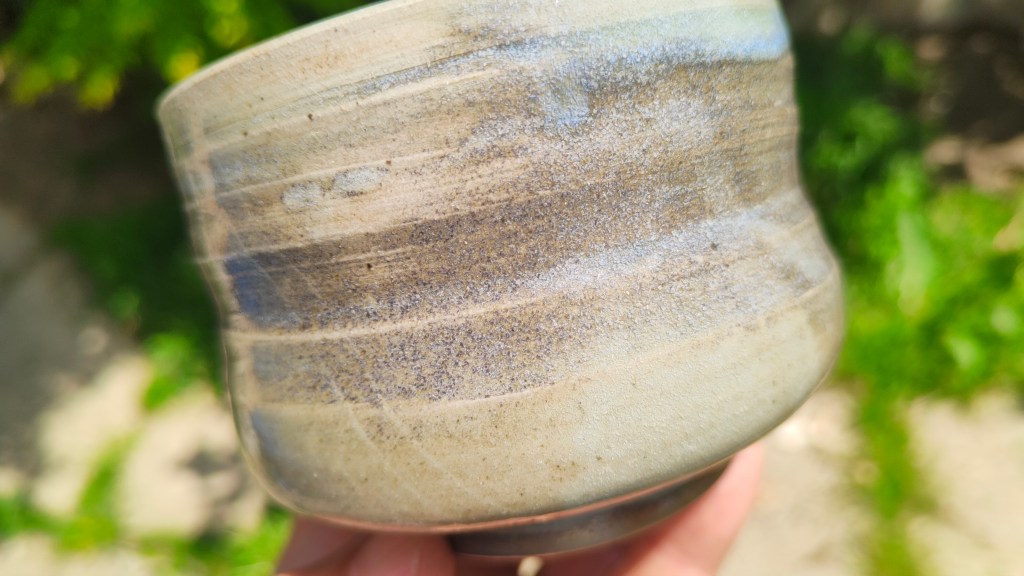
The 2nd attempt on white clay. Glazed too thinly outside. But you can see carbon trapping and nice blue chun effect where the glaze is thicker.
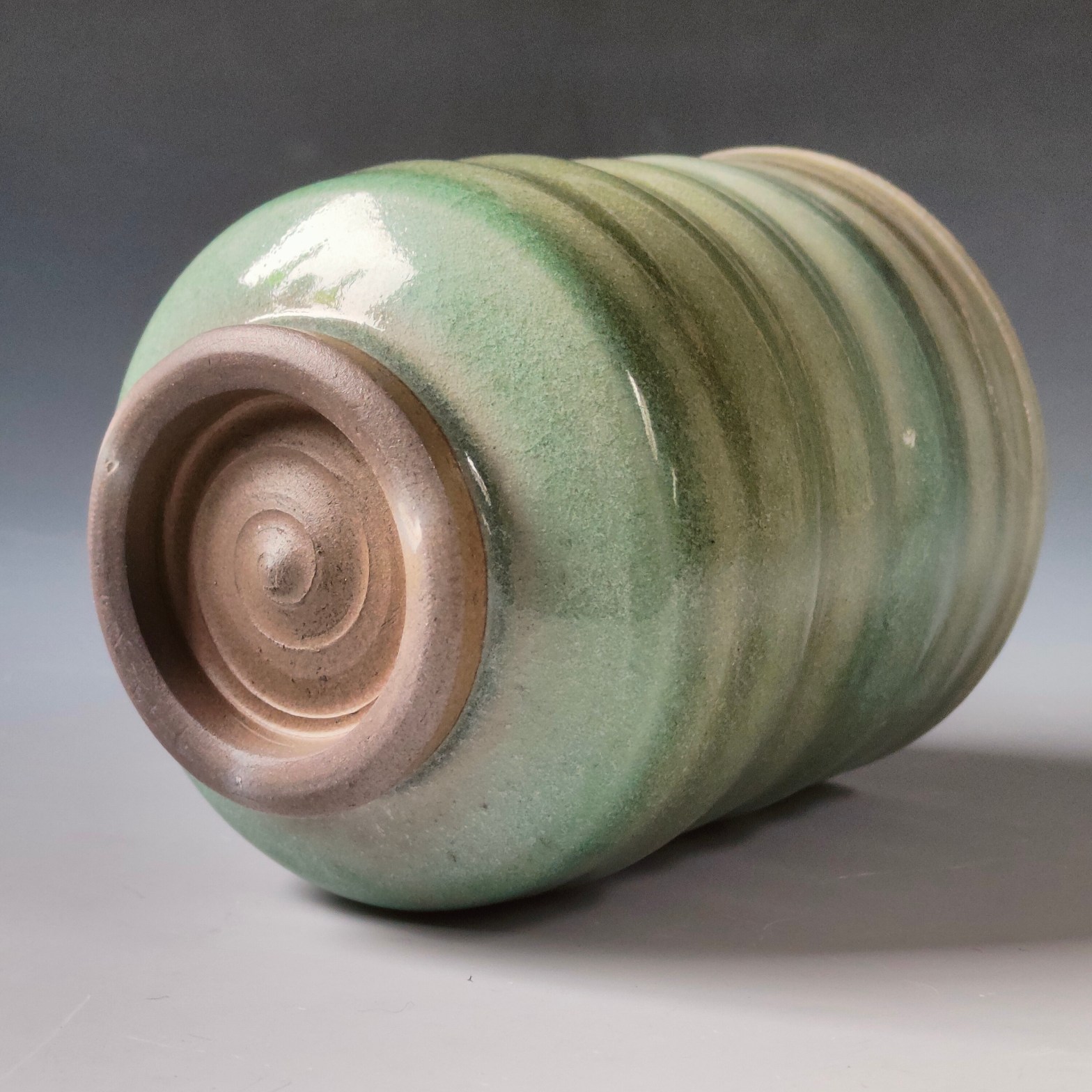
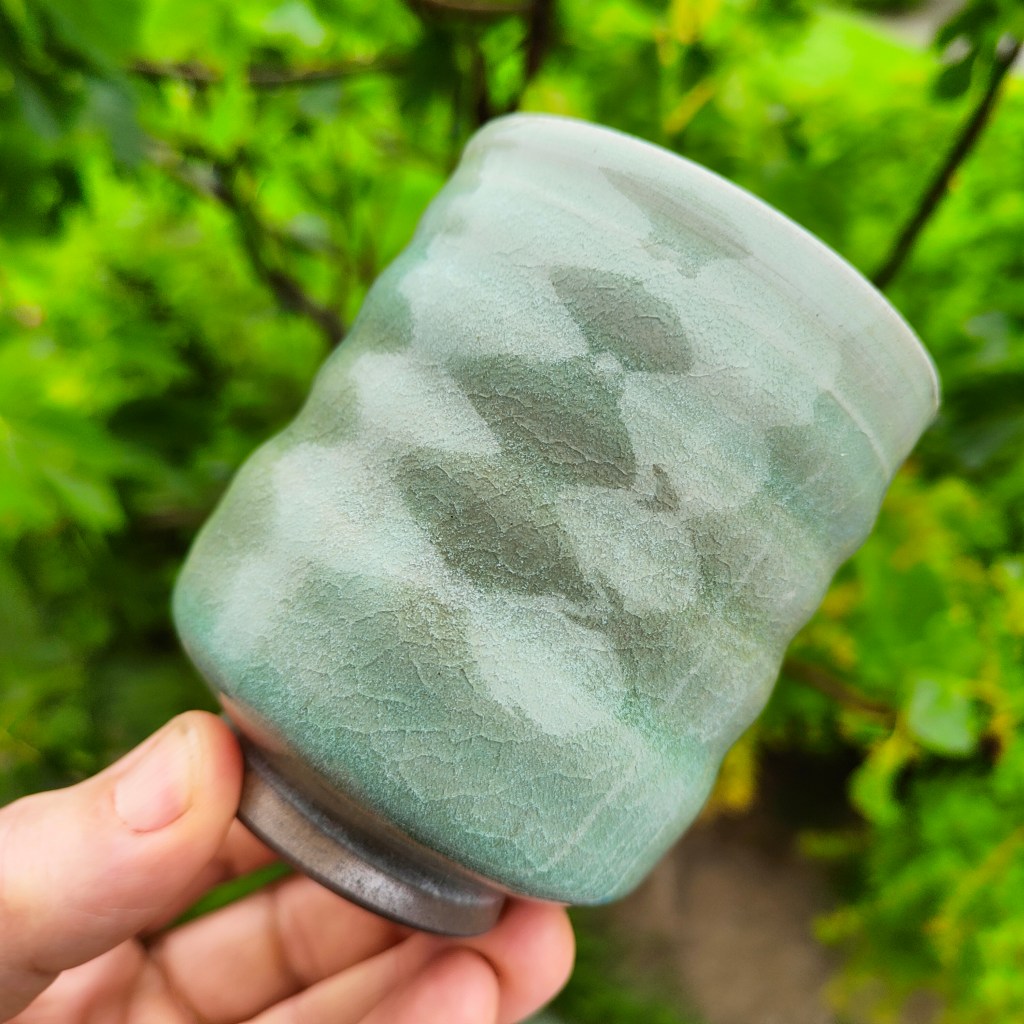
For the third and most recent attempt, I did two saggars, each with a cup glazed with the same Selsor chun. This time I made sure to get a good thickness of glaze. Both came out really nicely, though not looking how I expected Selsor chun to look (a shimmering blue chun). One came out a lovely darker green with no obvious crazing, the other came out a crazed and lighter green with a hint of blue in places.
Both were on an ochre-coloured iron clay and I am not sure why I got different results from the same glaze. Maybe it was down to one having more charcoal in the saggar, or in fact they were different clays and I didn’t check… Overall, I suspect it is the amount of charcoal, and carbon released, getting trapped by the glaze.
Attempt 3, Selsor chun on ochre-coloured clay. Very nice, if not what I expected from this glaze
To summarise what I think are key things to take into account: use a low-iron or white clay, seal the lid well, don’t add too much charcoal thinking more must be better (try and gauge a moderate amount for the size of saggar). I am wondering if it might be worth weighing the amount of charcoal for a given size of saggar, so as to achieve consistent results.
An idea that has just occurred to me is, could putting larger chunks of charcoal delay most of the burning till a higher temperature? I tend to make the pieces quite small (hence producing a larger surface area). Later reduction could reduce carbon trapping and lower the risks of black coring on iron clays. That’s one for the next test…
I plan to try some other glazes: tenmoku, copper red and wood ash etc. Putting one or two per electric firing. Though now the weather is warming up here in Croatia, I will next be firing to cone 9-10 in my gas kiln. So the saggars may be a little while coming – think December 🙂 I will do another post when I have some useful results.
I hope you have found this info of interest. Remember, there is a risk to your kiln’s health if you fill it with reduction gases. With this post, I’m showing what I have done with saggars, but not saying you should do it.
After two firings, and a rebuild in the middle, building the new gas kiln was working pretty much as well as I’d hoped. As detailed in the build post, the first design was too long and colder at the burner end, so I shortened and raised the kiln chamber to match UK potter Iain Shield’s design. I also enlarged burner ports and flue to get more air going through to stop the smoking issue when I first lit the burners.
For firing No.2, after a few hours with the kiln around 100C/212F to drive off moisture, I took about 7.5 hours to get cone 9 down in the front half and cone 8 down at the back, which is pretty good and I wasn’t rushing. I had a very smooth linear temperature rise through the firing.
I think there is a little hot spot right at the front by the flames that might reach cone 10 too. One has to not put the pots too close to the flame or you may get blistering in the glazes or bloating in iron clay (which I did).
I wasn’t sure I had maintained enough reduction from 1100C/2012F, so I put it in heavy reduction at the end for 30 minutes and all pots were well reduced, bar one copper-glazed cup that had a patch of oxidation.
The key lesson learned is that one has to use glazes for the right temps in the right places. Glazes that have a wider firing range are very useful so any heat variance with positioning will still produce a matured glaze.
The ideal solution, I think, is to have glazes that have ranges good for cones 9-10 at the very front, for 8-9 in the middle, back and very top. That works as long as you get all parts of the kiln to cone 8 or higher.
One needs to fire the kiln a few times to learn how best to fire it, how to position shelves etc, and adjust accordingly.
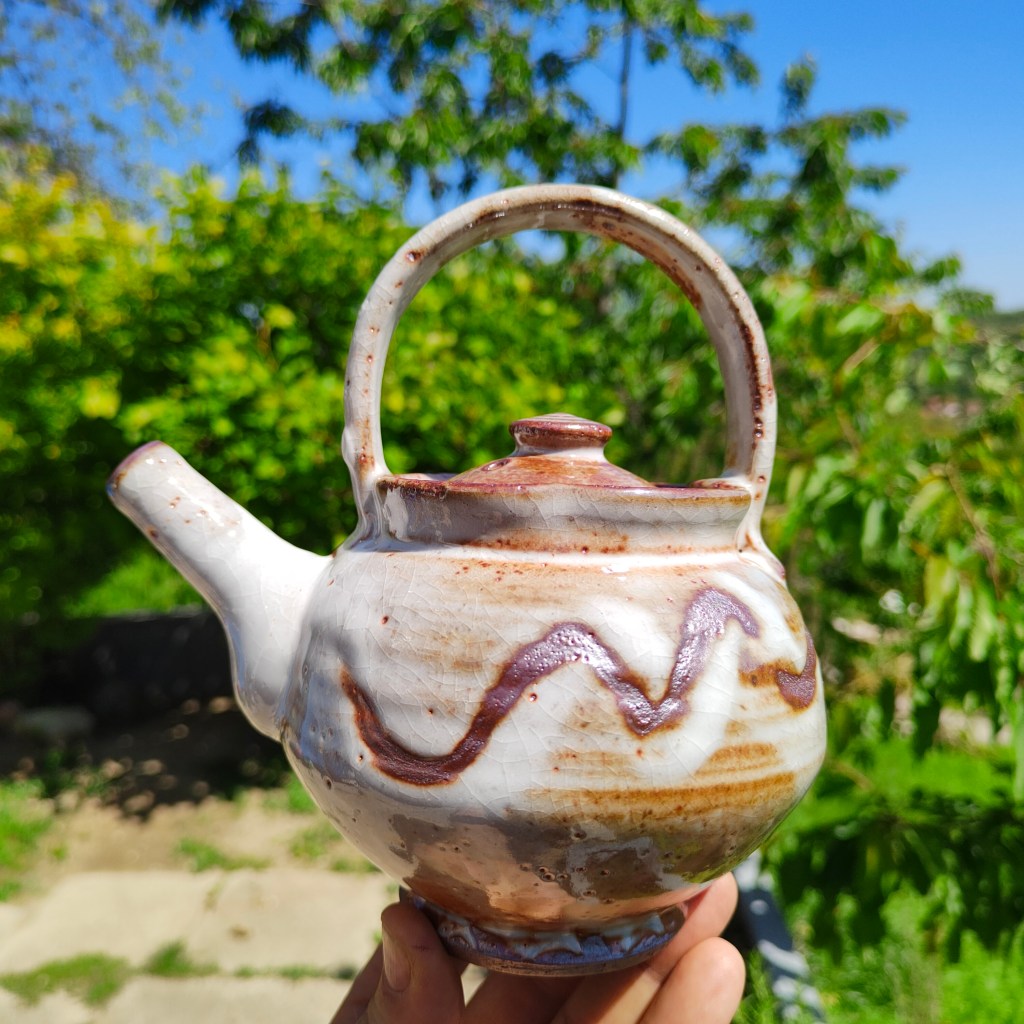
A shino teapot from the first firing. This got smashed by my cat a few days later, wahhh!
Firing No. 3: This was the best firing I’ve ever had! Most of the pots came out looking great, with just a few tests that were meh, and a few with the ash glazed pots sticking to their clay cookies after running too much.
I had actually really struggled to get the cones down during the firing, having squeezed in a little high shelf too close to the front where the hot gases enter the chamber and restricted the flow of heat through the kiln. So, the front got super hot – cone 9 was flat (I guess cone 10-11) while the cone 7/8s at the back were hardly moving. I sat up till 3am working to get those cones down and in the end they pretty much were down and my gas was running out.
(The lesson here is to make sure the shelves allow movement of hot gases around the kiln.)
The extended firing meant that even though I didn’t get cone tips quite down back and top, the glazes had well matured with heat work and nothing was underfired.
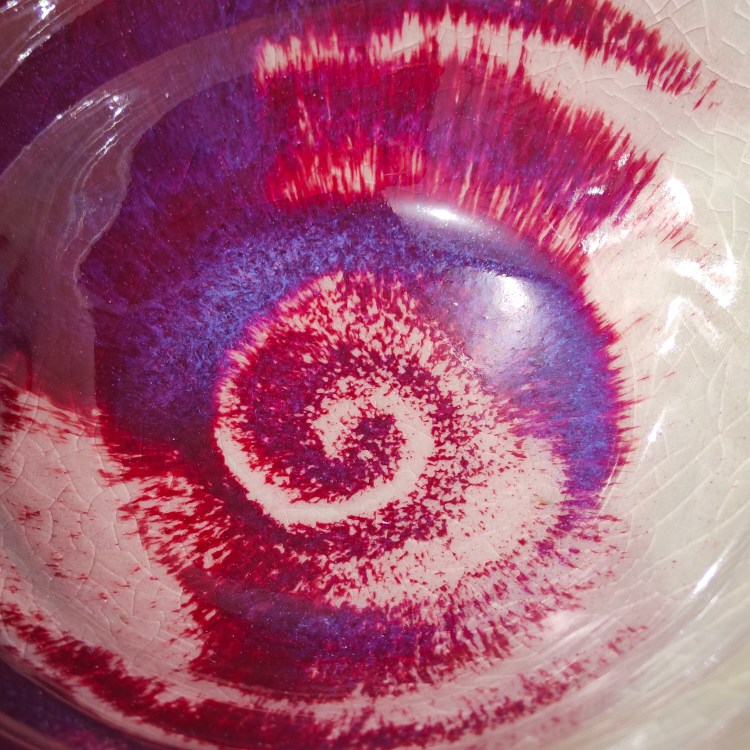
I had also lost reduction slightly at times trying to get the heat up in the later stages, but still everything did get largely reduced. Just my copper reds came out with patches of light green where they had had some oxidation. They are still beautiful.
This kiln does maintain good reduction – I think because of the floor layout. It was a mistake to go into oxidation to get more heat because I think it would have got there anyway in light reduction and the reds would have been more consistent. Even so, the results were mostly great.
As mentioned, I throw the kiln into heavy reduction at the end to try and make sure the glazes colours are as expected. However, I suspect this only works with iron-based glazes, while copper reds don’t return to red if you went into oxidation too long. That’s my theory anyway…
Partly oxidised bowl interior showing copper red glaze.
Firing No.4: I needed to fire a large moon jar which took a lot of the chamber height so, to make 20cm/9in space to fit a shelf above it, I added an extra layer of bricks on the top of the chamber. This brought the height to 11 bricks, when it was 10 previously.
I was a little unsure if this was a good idea, but I needn’t have been. The kiln fired as if I hadn’t added the extra layer and it all went very smoothly – 7.5 hours firing (not inc. warmup to 120C for a couple of hours and including an hour of soaking at the end). I got cone 10 down flat at the front and cone 8 getting a little squiggly at the back.
It was a little hard to get the top shelf cones down, so I kept soaking the kiln for a while. This cooler top was an issue last time I fired, so not all due to the extra layer of bricks. Or the effect was only slight. I am thinking about splitting my top shelf so hot gases can circulate more freely around the kiln and not get trapped in zones.
After unloading the kiln, I found some oxidation on the bottom rear, so it may be that the burners couldn’t make as much pressure with the extra volume (or maybe I just made a slight mistake with the damper control). Further, I had rebuilt the chimney due to robbing out insulating bricks for the extra layer on the chamber and the hard bricks I added back had slightly smaller dimensions – making for some gaps and hence a more ‘leaky’ kiln. I have tightened it up for the next firing.
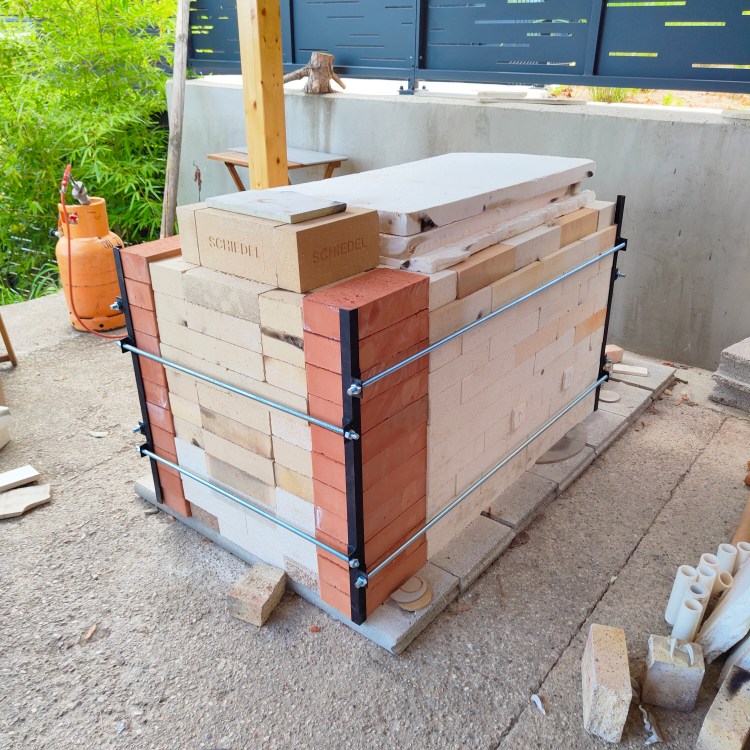
After getting the kiln to where I want it, I have also just fitted steel bracing around the kiln locking all the bricks in tight. Thus, I am hoping it will be less leaky and reduction will be easier to maintain throughout the whole kiln (as well as more structurally stable, though it seemed ok without bracing).
It’s hard to be exact, but I think the extra kiln height only uses a small amount of extra gas. Maybe 2-3cm of my 10kg bottles. Overall, it takes about 20kg of butane per firing. I use 4 x 10kg bottles: starting with half-full bottles left over from the last firing, then swapping to full bottles just when I go into reduction.
I can’t do the full firing on 2 full bottles alone. There is just enough gas, I think, but the pressure drops too much towards the end. I tried in my most recent firing (Sept 19, 2025) and had to switch to full bottles at about 1150C/2100F.
Maybe if I had better burners like those from Ward or Rohde I could do it on less gas. I made mine for about 20 bucks apiece, so I am happy to use them and accept a little inefficiency.
As for why I don’t use propane: it’s hard to get the 40kg bottles around my house to the kiln on a muddy path. I have started laying a nice smooth cement paving path on which I can use a trolley. Then firing on warmer winter evenings will be possible: butane freezes around 0C, while propane freezes at -42C. That’s a huge practical difference for the potter!
I need to calculate the new chamber volume with the extra layer, and I will add that figure here soon. It’s maybe 9 cu ft/254 litres, at a guess.
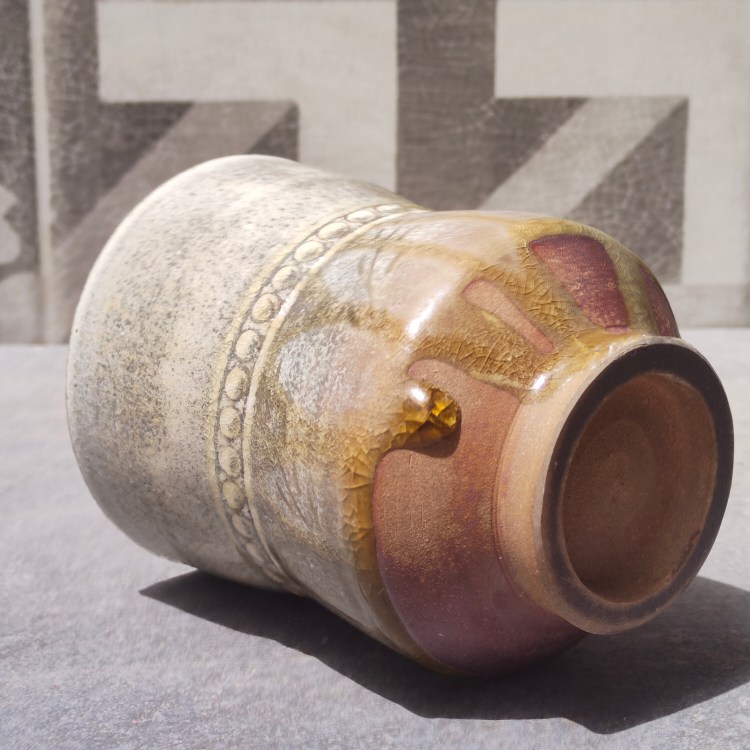
A yunomi cup that got both reduction and oxidation producing this lovely gold from the iron in the ash glaze.
I am currently making new pots for firing No. 5! Watch this space!
I have another post looking at how my pottery firing CO2 emissions compare with taking a plane or running a car and it is surprisingly little.
Note: I have a bunch of minor but important changes to the kiln since build No. 1, and made updates to some of the sections in this post. You will need to read through the whole thing to understand what is now final kiln. Some pictures are of the first build, some are updates on my changes, so do read the captions. Updates are in italics.
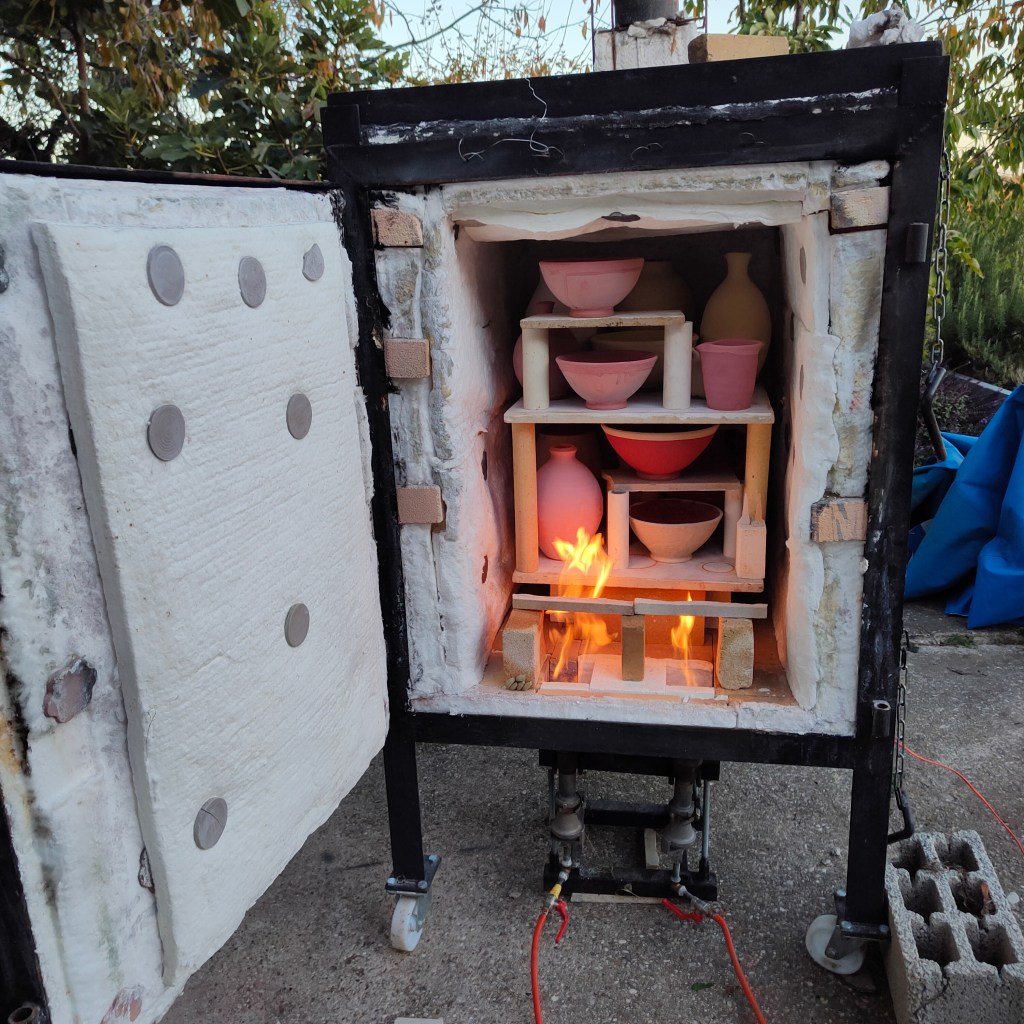
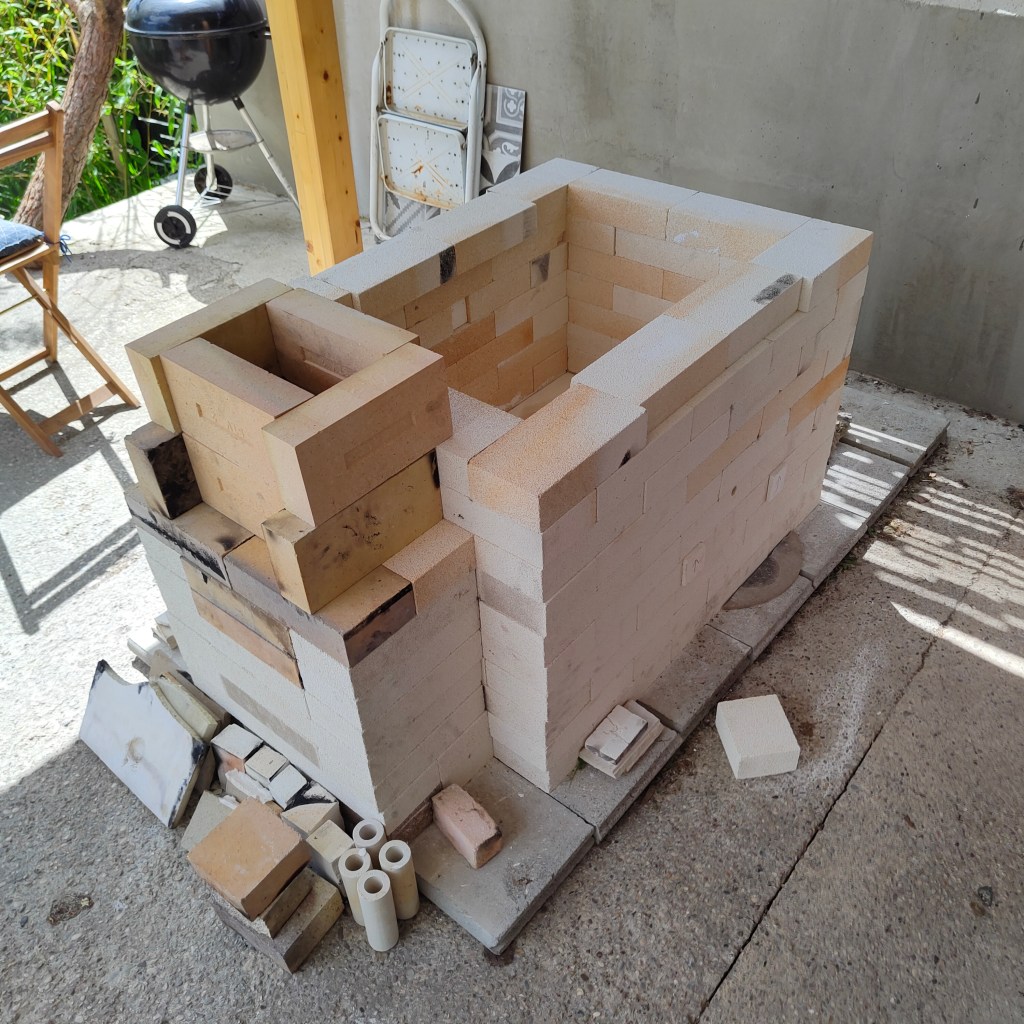
I hope it is not too confusing. You are welcome to comment or email me with questions.This first image below is the kiln ready for firing No.3, just so you have an idea.
The current design of the kiln, complete with steel frame. The fibre panels on the lid have been regularly breaking though and I will need a new system soon. See final image.
My previous gas kiln, while it works, is somewhat frustrating. It tends to fire hotter at the bottom and cooler at the top by quite a margin. I also get some oxidation in the bottom that isn’t desirable.
So I decided to stop messing around (and weeping internally when I had to throw half my fired work onto the growing trash-pot pile) and make a new, hopefully better kiln.
At first I thought I would make it from fibre blanket. A few layers (7.5cm total) would give me a good insulating kiln, fine for cone 9 going by past experience. On reflection, though, I realised that I would do better to spend the extra cash on some insulating bricks. These are better in that they insulate really well, they provide their own support (fibre needs a framework), they don’t deteriorate anything like as quickly, and they can be reconfigured easily and quickly – or used again in future kiln projects. And they don’t have the health risks of fibre blanket.
Ye olde kiln. Brick and fibre insulation downdraft. It works but is frustrating in some ways
So I arranged delivery of 150 bricks rated for 1430 degrees Celsius (2606 degrees Fahrenheit) in early April (cost 880 euros inc. delivery). I planned to fire in reduction (a carbon-rich atmosphere) to cone 9, maybe 10 if I can, for nice ash glazes, tenmokus and shinos primarily. That’s around 1260-1290 degrees C (2295-2340 degrees F).
The build
First, I laid some thin concrete blocks down as a base to protect the terrace concrete from any escaping heat. Ideally, I would have used a layer of hard high-temp bricks between the concrete blocks and the insulating bricks too, but the addition would have added another 180 euros onto the cost.
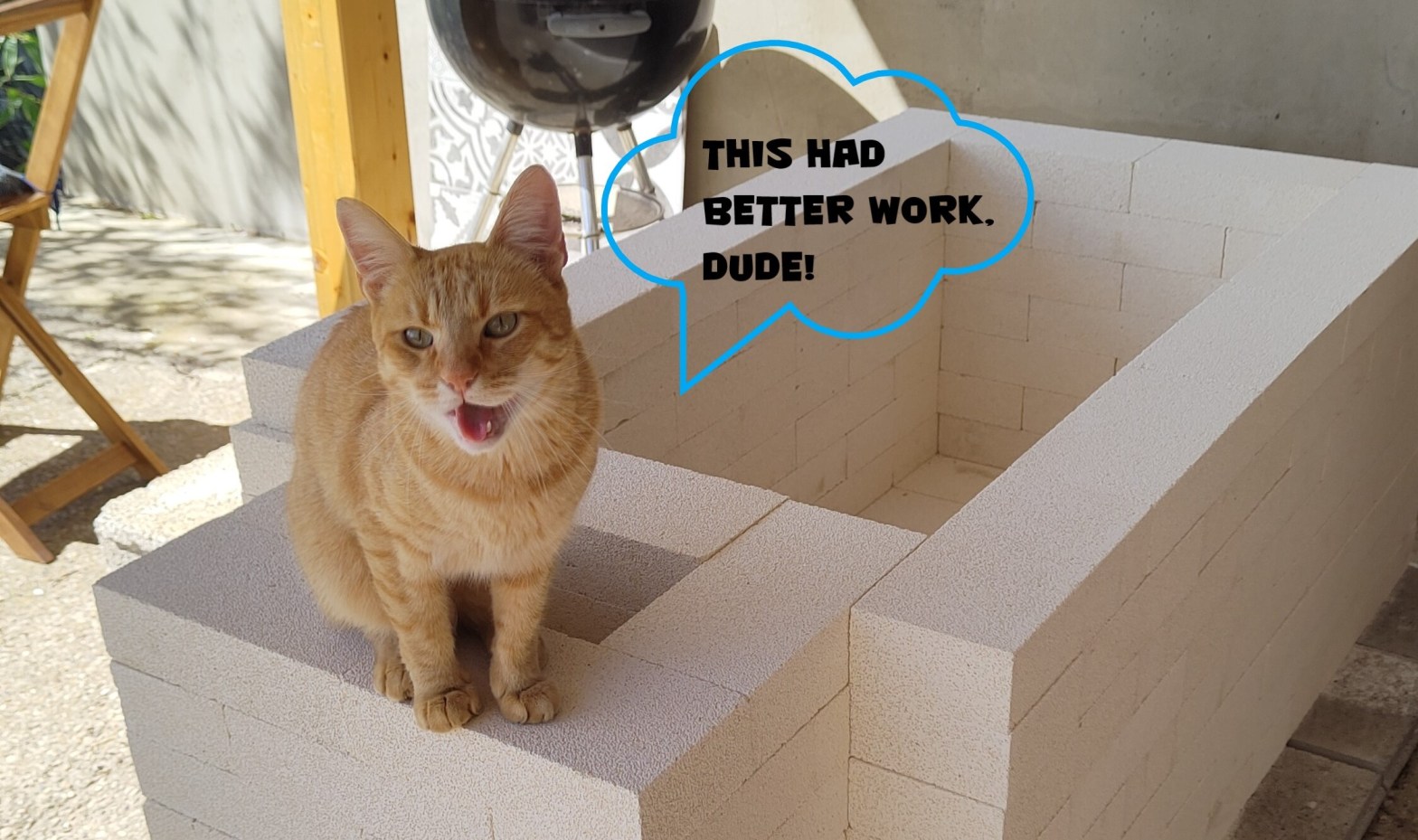
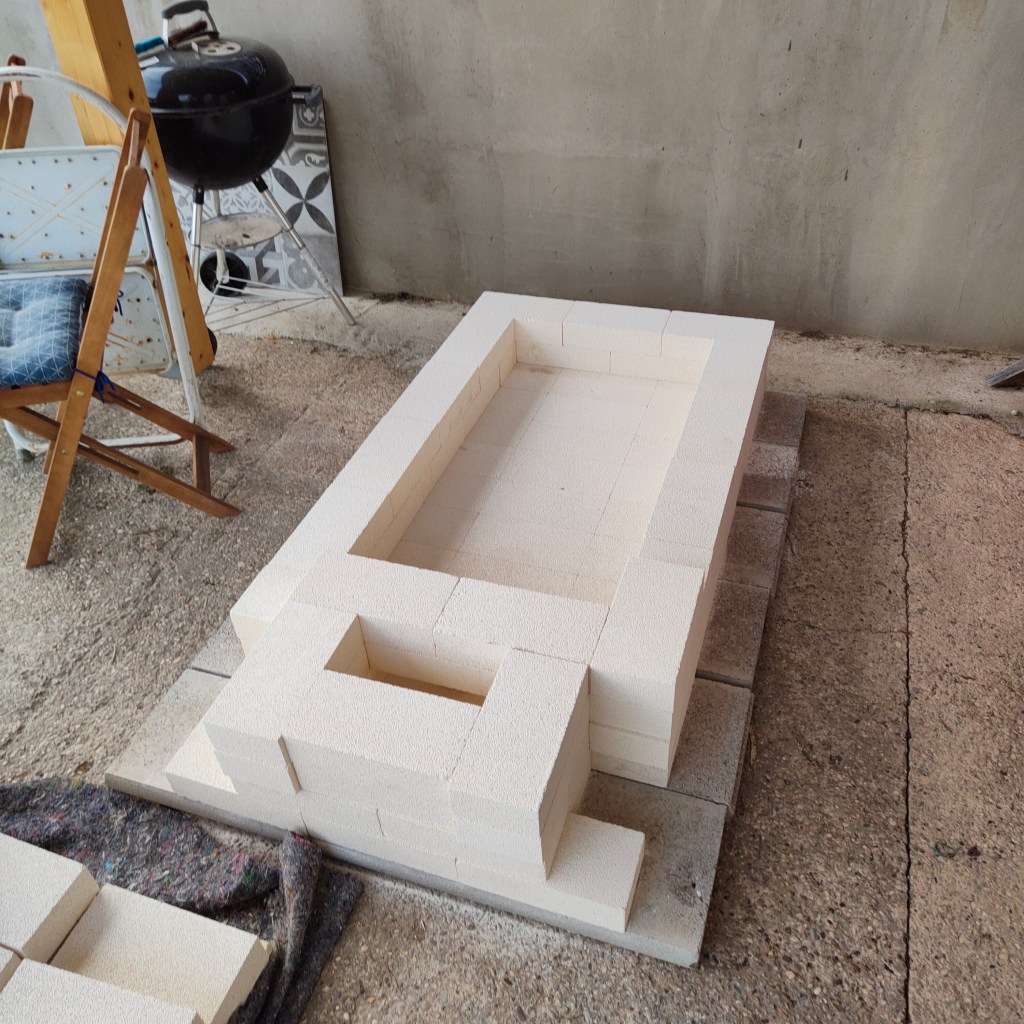
Building with bricks is very simple. It’s just like Lego play. Lay out the base layer to the floor plan you want, and build up walls in the offset-layers pattern you would use for a house wall – not forgetting to build on a chimney. One has to keep pushing the bricks together to avoid gaps and they often shift when adjusting another part. But it is easy enough to tap them back. In time I plan to add a metal frame to lock it all tight, but I want to test the format first (edit: I did do this, see the top pic).
One needs to rebuild sections when putting in the flue and ports, but on a kiln this size that literally takes a few minutes. I decided to put it up and see how it looks and work out the volume before deciding the design/cutting any bricks. With a little calculation of relative sizes, you can actually use Lego blocks to mock up the design and see how many bricks you need.
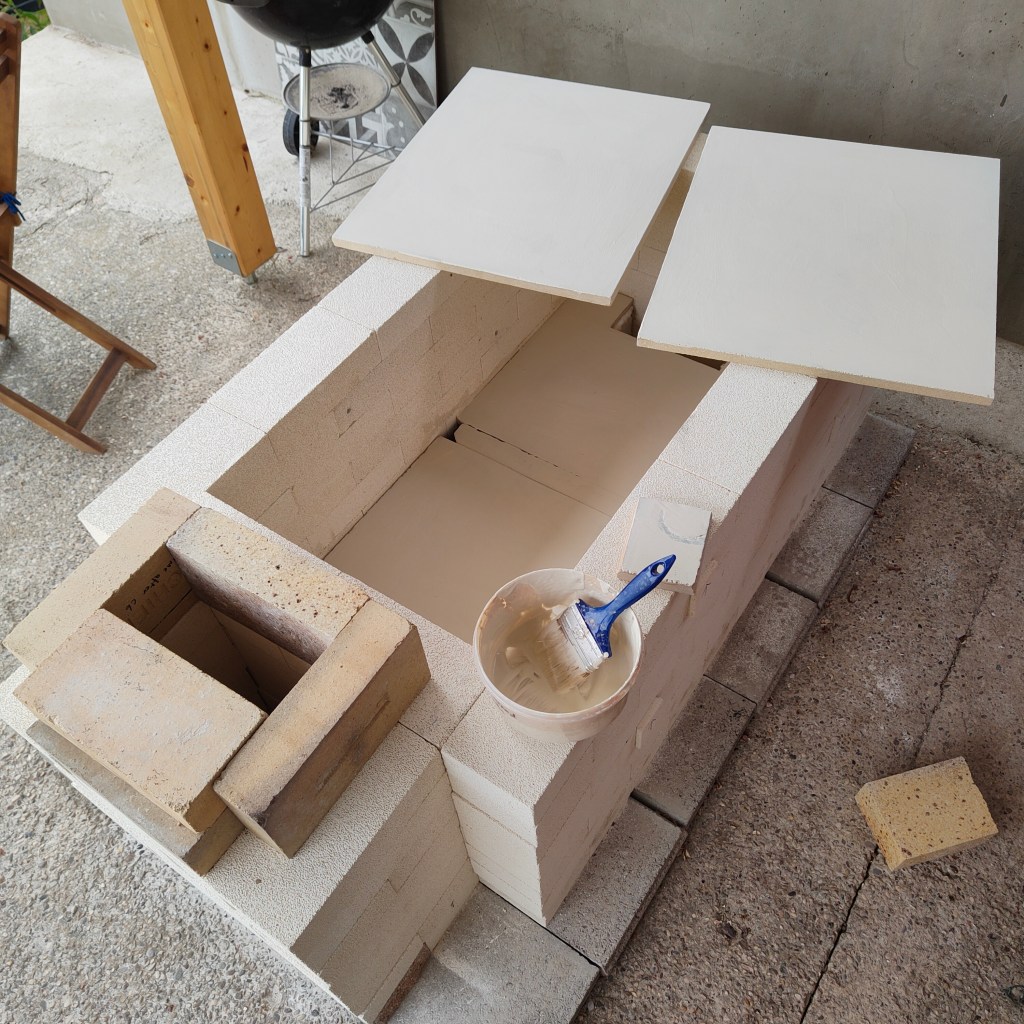
It’s worth also putting in the bottom base shelf and a couple of other shelves at sensible heights so you can see where would be the best sites for peep holes.
Starting to build the layers. I did get a little size variance in some bricks, which wasn’t ideal but no big issue
One needs to make sure the kiln is sited far enough away from anything flammable, of course, including decent clearance for any rafters above. I do have wood at least a metre away at the sides in the kiln’s temporary location under my veranda (I plan a dedicated shelter soon). That should be fine since the bricks insulate so well, you can touch them at high temps and not get burned. If I find the adjacent wood getting too hot, I can protect it with kiln shelves or house tiles during firings. (edit: it only gets warm and is no risk)
For my initial design, I chose to make the ware chamber two times longer than it is high to avoid the vertical temperature differences I’d had with the previous kiln (that one is a bit taller than it is long).
I made the box 3 bricks wide by 5 bricks long by 8 bricks high. That gave me a 100cm long by 50cm wide by 45cm high internal space (that’s 39.4L x 19.7W x 17.7H in inches). In empty volume, that equates to 225 litres (or 7.9 cubic feet), if I got the sums right.
The bricks are 25cm long x 12.4 cm wide x 6.4 cm high.
For this project, I was guided by builds from Iain Shields at Shield Studio Pottery. Iain makes a design very similar to what I had planned, with some key differences, and its success has seen him make kilns for other potters.
Iain builds his kilns higher and shorter than my build No. 1: 3W x 4L x 10H bricks.
After my first firing I found that, while the vertical temperature difference was minimal, the ‘back’ end of the kiln (where the burners are positioned) was quite a lot cooler (barely cone 7). The front had got to cone 9+.
So I rebuilt the kiln chamber (which only took a couple of hours including cutting shelves and moving ports around etc) to match Iain’s dimensions: 4 bricks long by 10 bricks high by 3 bricks wide. On the second firing, this turned out to be much better. I got cone 9s down at the front of the kiln (chimney end) and cone 8 down at the back.
This also gave me better height for taller pots and more shelves. Reduction was good over the whole kiln, as long as I didn’t mess it up trying to hit top temp.
Late 2025 firing edit: I am now getting cone 10 quite evenly across the kiln. One has to be sure to not obstruct movement of gases with over-tight-fitting shelves.
A later addition saw me put an extra layer of bricks at the top of the chamber too, so it is 11 layers high. In firing No.4 I tried this and it made no major difference to the firing or fuel use! I imagine it has about 9cu ft/254 litres in kiln volume as a result. I have to take measurements and check that.
I do have some trouble getting enough pressure to get a reduction flame out of the bottom peep holes but the work has nearly all been well reduced. That lack of pressure maybe have been due to the slightly loose bricks (that expand and loosen in the firing), which could be partly fixed by locking it tightly in place with steel bracing. (I did this later. It didn’t fix the issue)
I find that visually checking kiln atmosphere helps – if the gases inside at high temps look ‘misty’ it’s a reduction atmosphere. If clear, it’s in oxidation. Obviously you want some flame coming out of the chimney to be sure of good reduction.
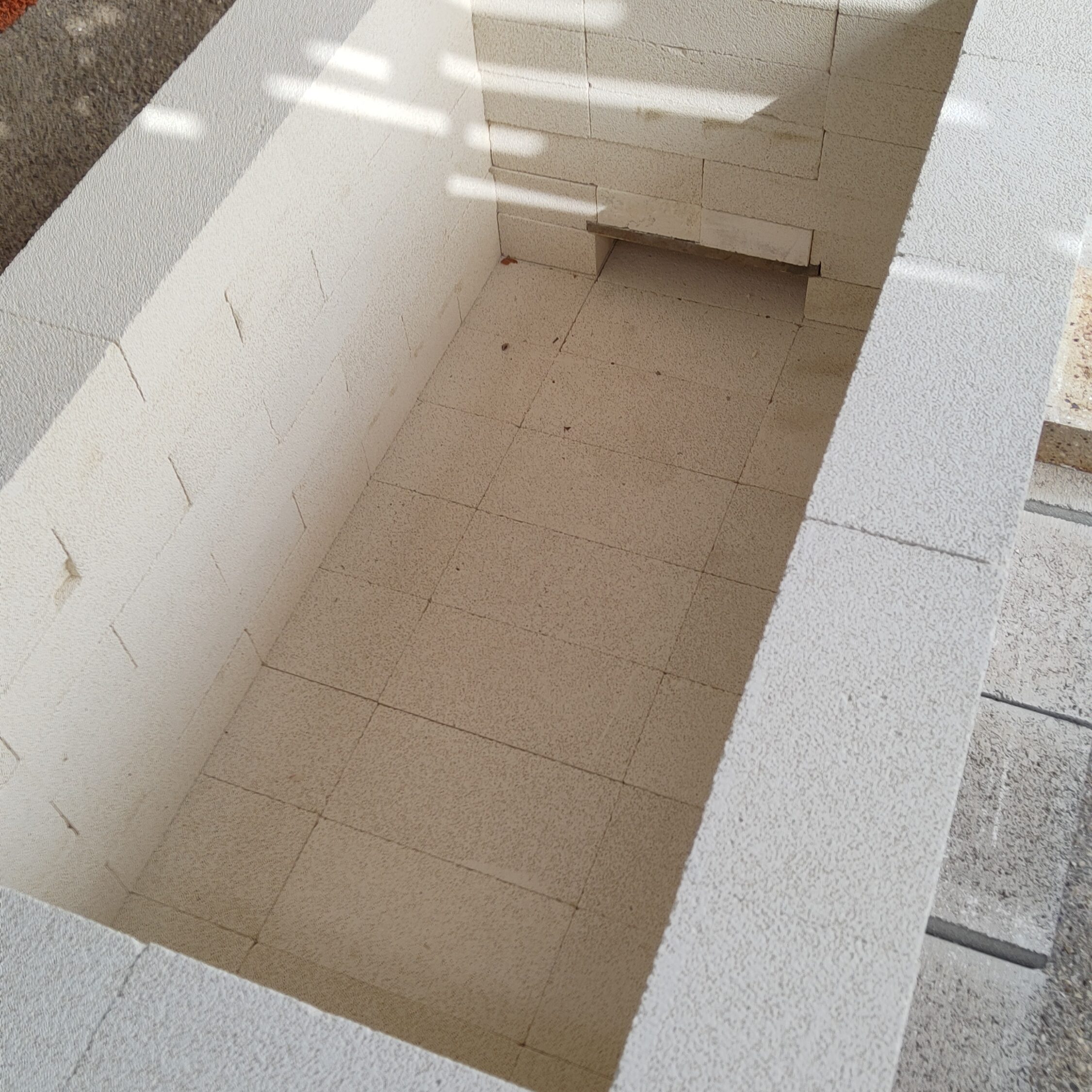
Flue layout – a bit of shelf supports the weight above (the flue was later enlarged for better movement of gases)
Flue set-up
The chamber obviously needs to connect internally to the chimney stack. For the flue passage, I first made it the size of the long side of 1 kiln brick. This gave an area of 160cm2 – more than the minimum needed for the kiln volume, which is around 130cm2. That was calculated with help from Iain’s website (referencing Fred Olsen’s kiln book). He cites Olsen as recommending “2.5 square inches of opening for each cubic foot.”
2.5 inches squared = 16.129 cm2. 7.94 (kiln volume in cu ft) x 16.129 = 128cm2.
Further, I know from previous experience that the flue should be a bit bigger than the burner ports combined. I did have that so it seemed good. (The burner ports were 2x 7x7cm (2 x 49cm2) so I had 98cm2 of burner port area versus 160cm2 of flue area.)
To support the chimney bricks over the flue, I cut a piece of kiln shelf to slot into grooves I cut in two of the bricks. I used some old pieces of insulating brick to fill the narrowed brick space above it (rather than cut a nice new brick. I hate doing that if I can avoid it).
However, during the start of first firing, I had a lot of smoking when on very low burner pressure, so I stopped the firing, opened it up and doubled the flue to the chimney and enlarged the burner ports. This fixed the problem – I think the larger burner ports was key since I had lots of air coming in to help combust the gas.
It now takes a few minutes for the flue to heat up to get a proper draw so it may smokes very slightly until then (with my DIY burners. I can’t open the air up so much on low gas pressure).I also move the burners back to maybe 8-10cm from the ports so more air can enter in the early stages. Once the kiln is hot I put the burners closer to the ports.
I didn’t have this issue on the old kiln because it had larger burner ports from the start and a long chimney creating plenty of draw.
Making the under-floor flue system
This is a downdraft kiln design, which means that the gases enter from the burner ports, go up over the pots and then go down (hence ‘downdraft’) and out a flue at the base level before rising up the chimney.
Iain came up with a closed floor shelf plan that guides the hot gases through the kiln – ideally meaning it will get fairly even heating and reduction throughout, and also maximising ware space. I had initially thought I would do a more traditional open floor design – with gaps around the floor shelves so gases will be allowed to circulate more freely – but when I was building it, I decided to follow Iain’s tried and tested plan. I can always open it up in future, if I want.
I did reach out to Iain and he said that there can be cooler spots in his kiln design – more towards the outflow hole in the floor (the opposite end from the chimney.) After firing the kiln, I find a 1 to 1.5-cone difference between front and back. That’s very manageable.Extra edit: In my most recent firing (Nov 2025), I had only one shelf in and the kiln rose easily to cone ten or 9.5 over the whole volume. It was a great firing with everything reduced. Shelf layout and/or pot size and positioning can definitely choke the kiln and make problems with airflow.
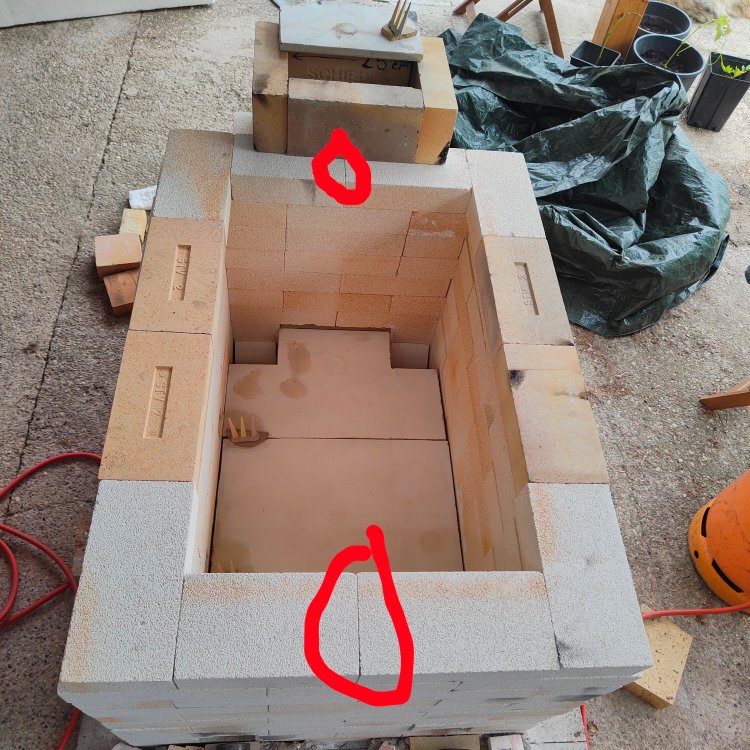
Making the floor initially involved cutting some 10cm-wide strips of kiln shelf and standing them on their edges to act both as supports for the floor shelves and to separate the incoming and outgoing gases.
Nearly there. I added extra shelf pieces at the near end to close off the flue channels
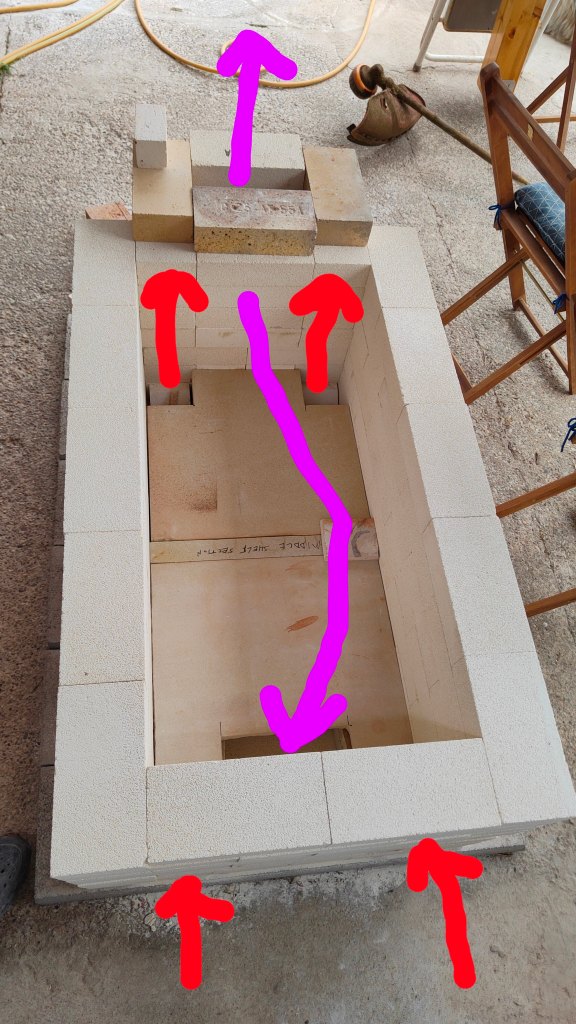
From the two burner ports, two side channels allow incoming flame to flow under the floor and enter the chamber via two holes at the chimney end. A larger single hole at the centre of the other end allows the gases to leave after they have heated the ware, passing back under the floor to the exit flue.
The old shelves I cut up for this were 1.6cm thick – a bit thin to stand on edge and still be stable (especially since I cut them with an angle grinder. I had to level them with my big belt sander too). But they did stand and once the shelves were in place, they became very stable. The shelves sitting on them touch the walls, locking the whole structure in place so they can’t wobble over.
Because I was working from old pieces of damaged shelf I didn’t have long enough pieces to make four 50cm strips to run the full 100cm on each side with only one division in each. So I ended up with two short pieces at the burner end that weren’t filling me with confidence. I put a little ceramic fibre on top of these little uprights to more firmly jam them under the floor shelf. That looks to have done the job and they are locked in place.
No doubt, 2cm-thick shelf strips for the channel dividers and no short sections would be more secure.
On these supports one places shelves to form the kiln floor that are cut to provide the ports for hot gases to enter and exit the chamber. Once hot, the kiln’s draft pulls the gases through. The ‘in’ floor ports are about 10cm square and the ‘out’ port is slightly smaller than the chimney channel in area (the top side of 1 brick). That should be plenty for free movement of gases. When I rebuilt the kiln for firing No. 2, I made the latter hole a little smaller as I was wasting a little pot standing space.
I placed half bricks cut at 45 degrees in the ‘in’ channel ends to deflect travelling hot gas upwards into the kiln – a la Iain and originally, I believe, inspired by Simon Leach kiln builds.
My one concern with this floor system was that the shelves could crack with direct contact with the flame before the chamber has got sufficiently hot. In the actual firings, I found this not to be the case. I did try to keep the temperature rise gradual to avoid this issue.
Iain seals the floor shelves around the edges and joins. I don’t feel the need to do this. A small amount of heat leaking into the chamber early will not hurt anything (the gap between the floor and walls is tiny). I may yet do this to better seal the kiln for consistent reduction.
Somewhat dubious arrowing to show the way hot gases move under the floor and out, again under the floor, via the flue and chimney. Red in, purple out.
Cutting in burner ports
I originally tried to cut the burner ports with a circular cutter on a drill. That failed since it would only cut a few cm into the brick and, even with cutting in from the other side, I couldn’t make the tool cut all the way through.
After faffing around trying to extend the circular holes with hand tools, and just making a mess, I ended up cutting out roughly 7cm square holes which do the job just fine. The extra gaps around the burner heads will allow more air into the kiln to help combust the gas. As burner expert Mark Ward says in this very useful essay, a kiln must breathe.
As mentioned above above, I had to further enlarge the ports to more like 10cm square during the first firing because the low chimney meant little draw and smoking from poor combustion of gas. They are actually rectangular now due to the max height of a brick.
Burner ports. I know, they came out slightly wonky – but the burners don’t care!
Chimneystacking
The chimney is a simple stack that has a hollow interior the area of 1 brick on its largest side. Iain does this in his design, so I did the same.
I have added an extra layer of side-up bricks at the top of the chimney (compared with Iain’s design which stops flush with the kiln chamber). This should increase the draw through the kiln and further allow me to have a tighter flue if needed by moving one of the bricks inwards.
For fine control of oxidation/reduction, I place a piece of kiln shelf on top as a damper to be able to easily open and close the top. Of course, my Venturi burners also have air control wheels for this purpose. One uses both methods in a firing, but it is mostly done on the damper once reduction has started.
Those buttress bricks at the base of the chimney weren’t needed and I removed them when I rebuilt it later.
Ports for peeping and pyros
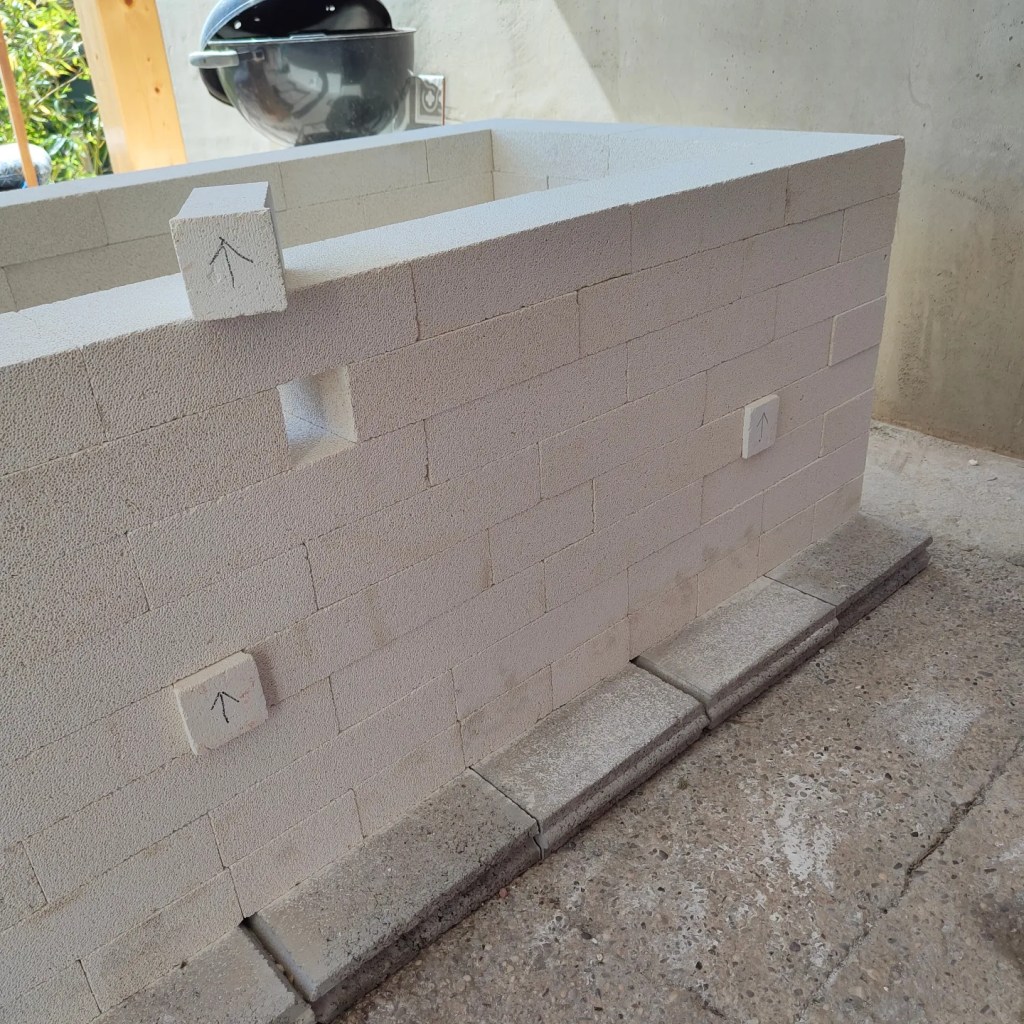
To finish the kiln body, I opened three peep holes in one side wall to allow me to check cones and the kiln atmosphere. (If you get a yellow flame out of the peeps, you have reduction and sufficient internal atmospheric pressure.) Two are just above floor level to give views of cones on the bottom shelf (placed towards both ends of the kiln to monitor hotter and cooler ends, potentially). The third peep I put above the top shelf level and towards the chimney end.
For the peep-hole bungs, I used some insulating brick sections I had left from earlier projects. These are filed to fit and very slightly tapered at the inside tip to easily slot in without dislodging bricks in the hot later stages of the firing.
I gave the bungs a little raised rim on the outside ends so they won’t slide into the peep hole too far, and providing finger grips to make them easy to extract when the kiln is hot (also an idea from Iain).
When I rebuilt the kiln for firing No. 2, I moved 1 peep hole to the other side to be able to make sure both sides had reached temp.
Three peeps – two on the bottom shelf front and rear, and one up top nearer the chimney
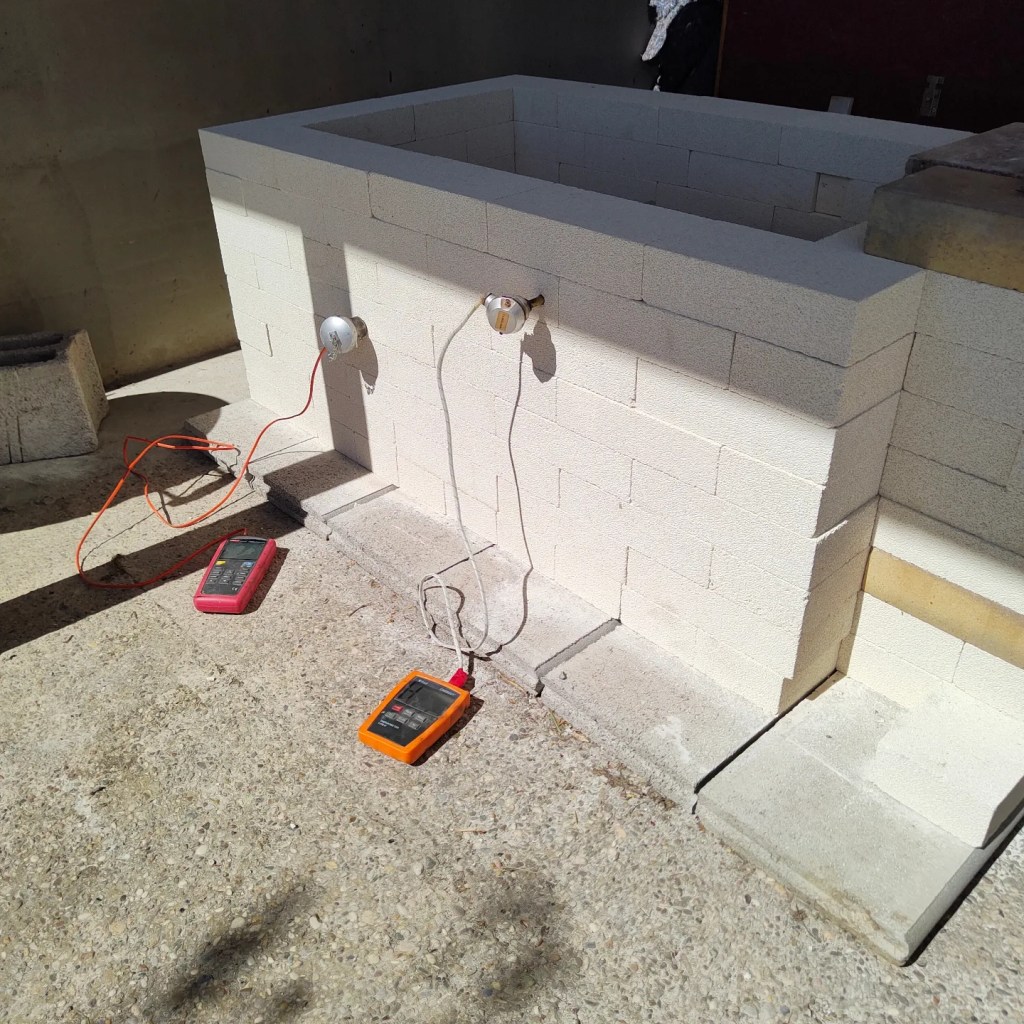
I drilled two 1cm holes for my thermocouples (high-temp digital thermometer probes) in the wall opposite the peeps. Since I have two (K and S-types), I thought why not use both? It can be really insightful to track the variance in temp between top and bottom and see how gas level effects any difference. These again are sited high and low and towards either end of the kiln.
This proved very useful. In the first two firings I could see if top or bottom was higher. For the second firing, I also moved one thermocouple to the other side so I could track left and right and was able to adjust the burners to keep the climb rates close.
Luxury – two thermocouples! Useful to gauge rise differences top and bottom and front to back
The roof conundrum
The roof is generally the trickiest part of building any kiln.
You either:
Build a brick arch – very tricky, needs a lot more bricks and metal bracing, and generally only worth the effort for a kiln that is bigger and will never need to be moved (mine will).
Bind a bunch of bricks firmly together into a flat top so they won’t fall into your pots at high temp – also a little tricky and very heavy to lift off if you don’t have a structure to hinge it on or to attach a pulley system to.
Or you make a flat top of something lighter and not prone to collapse – either fibre blanket on a metal frame, or fibre board, or kiln shelves + fibre blanket over.
Wanting something less prone to sagging and disintegrating than fibre, and not being able to source fibre board rated to over 1300C in the EU (or so I thought…), I opted to go with shelves for the roof and ordered two of 50x60cm for 1300C.
To hopefully sidestep the issue that shelves can crack from thermal shock if the edges are exposed and hence cooler than the centres, I planned to sit the shelves in a cut groove on the inside of the uppermost chamber bricks. That would allow the kiln’s heat to pass right to the extremities, lowering the risk of cracking. Fibre blanket would be laid over the whole top to insulate the roof.
But then I got a reply to an email I sent to UK-based refractories maker Vitcas (where Iain sourced his fibre board). They sell 25 and 50mm fibre board rated for 1430C and can ship to the EU from their plant in Poland (I live in Croatia). It was a very reasonable 150 euros for a 50mm-thick board of 100 x 120cm, but a hefty 120 euros for shipping! I bit the financial bullet and ordered it anyway because board wouldn’t (or so I thought!) have the cracking issue of shelves or pose the breathing hazard and sagging issue of fibre with repeated use.
I later realised the shipping cost was high because the board comes on a wooden pallet to protect it from breakages.
One board is way more than enough to cover my kiln, and in fact, by cutting it in half (producing two sections of 50x 120 cm), I had just enough to double it up for 10cm of insulation.
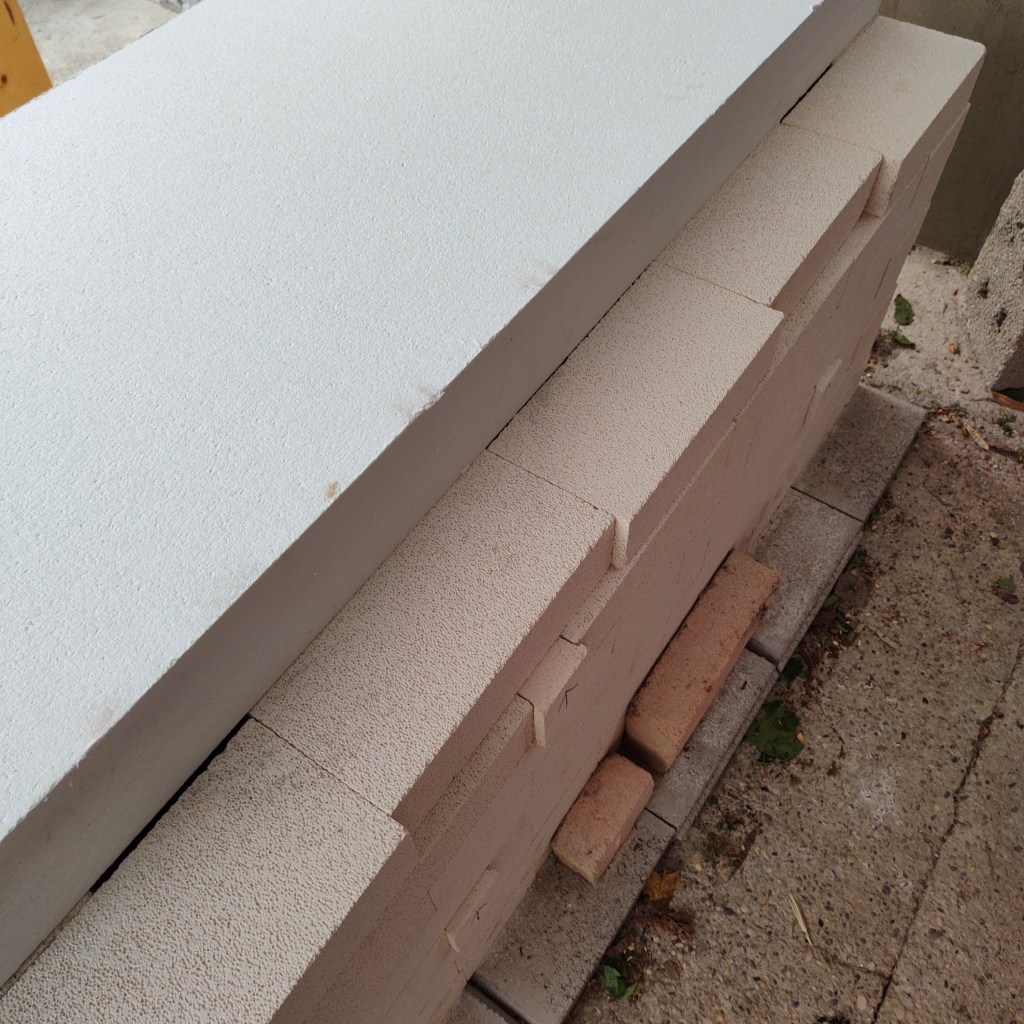
The cut sections overlap with the brick walls at the chamber ends, but there’s no overlap at the sides. So I corbelled (offset) the top side-wall bricks inwards by 2cm-ish, meaning the board has support all round. I still have slight gaps in a few places where I can’t offset the bricks without cutting bricks. I later did fix that for firing No. 3, corbelling bricks all along the sides. When firing, I also put strips of fibre blanket under the board edges so as to maintain good insulation and seal.
If you have the board a bit wider, you won’t need to offset the bricks. I do recommend the fibre blanket gasket around the edge to seal it better, as the board curves a little in firing.
Roof roughly in place. You can see where I offset some bricks for support at the sides. I later did the same for all side bricks
To divide the board, I used a thin and very sharp knife, trying to cut right down the centre line at 90 degrees, as I had no extra material to allow for wandering cuts. This is a really hard task, as the board is not at all easy to cut. By far the hardest job of the build!
I didn’t know how structurally strong the board was, though it seemed good and tough. It abrades quite easily if you slide it on rough surfaces, so one has to carefully place in in the right position as much as possible.
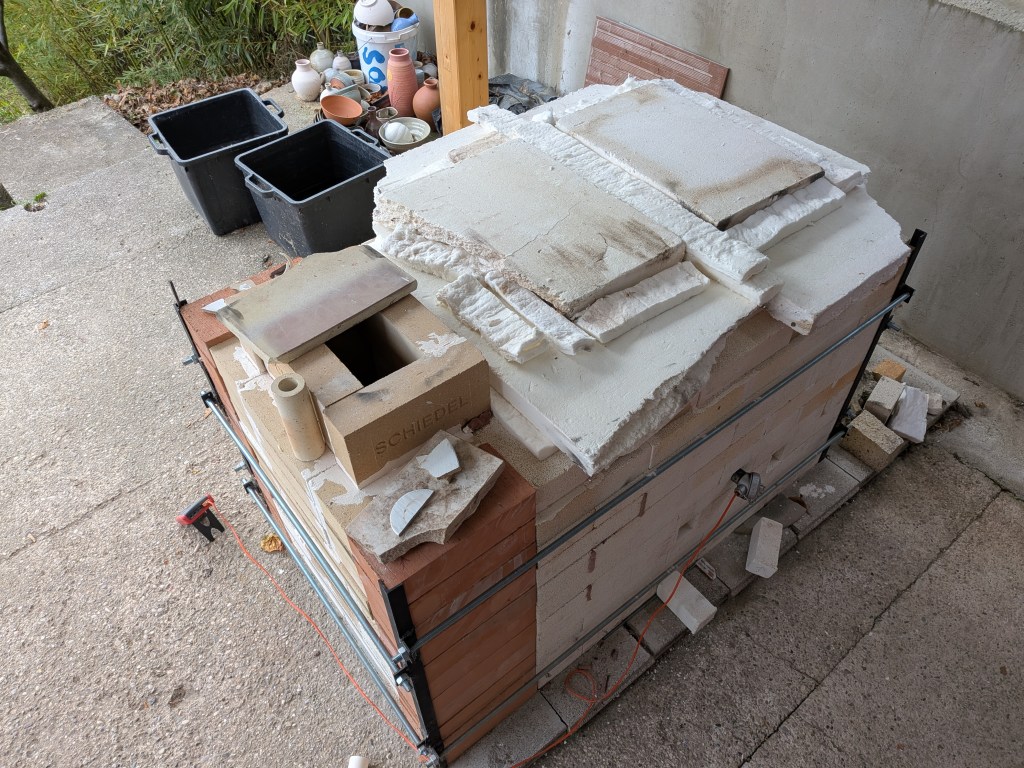
However, after the first firing, I found the lower board had curved due to heat differences and varying shrinkage. Worse, it had formed a crack. In the second firing it actually broke when I lifted it off the kiln! I now have one good board to try not to break or bang goes 300+ euros! The larger broken piece is just long enough to cover the chamber space sitting on top of the lower board for double insulation.
I think I would recommend fixing the board in a steel frame so it has support and doesn’t crack. One would need to cement it in the frame or use ceramic buttons and high-temp wire. I may yet try and do this, though my board is in quite bad condition after 4 firings.
The v2 kiln ready to close up and fire. I put fibre blanket put along the chamber rim, settling the board into it to seal the chamber
Note: Iain took the flat-top option for his kiln, using very long bricks locked together with steel bracing. On a build for another potter, he used fibre board held in a steel frame, adding coils of high-temperature rope to make a seal beneath.
Update after firing no.3
Here’s where I opted to cut pieces out of a couple of bricks to allow me to corbel all the side bricks inwards a little, to support the fibre board all the way along the sides, and give a better seal during firing. The picture below shows where I cut the two bricks I cut to give room for the side bricks to slide inwards. I cut about 4cm off each (one at each end), allowing movement of 2cm on each side.
I also opted to swap out two soft bricks and put in two hard bricks on each side. This was to bring greater stability when the board was on top in the firing. The light soft bricks had a tendency to start tipping slightly when its weight was on the inner edge. The much heavier hard bricks seemed totally stable and didn’t make any noticeable difference to the insulative properties of the kiln.
Top layer of bricks corbelled in to allow the 50cm-wide roof to be supported.
Heat source
For heat, I have two Venturi gas burners that I built myself. These work pretty well but are a bit carbon rich on low pressures (as mentioned). I have no idea of the thermal output, but they fired my previous kiln of a similar volume to high fire temps. They have no safety cut-off system though, so I basically have to monitor the kiln atall times.
*I recommend spending the extra on burner safety systems that will switch off the gas if the burner blows out. If that happens with an unattended kiln before the interior is red hot, it can cause an explosion. You can also pay more and get burners with a pilot light so they reignite automatically.
Note: Iain uses free-standing Rohde 30kW burners with flame cut-off.
Final things
Snow white batt-washed shelves! For now, at least…
I gave all the shelves a good coat of shelf wash to help protect them from runny glazes. The cut floor in particular is it worth really looking after, as I won’t want to be cutting more shelves for it more than very rarely. I use clay cookies and small bits of shelf if I am worried a glaze might run.
Of course, some ash glazes ran off the pots onto the shelf in the first firing 🙂
If I had all the materials in place at the start, and had the energy and the knowledge of the build’s intricacies, it would have been less than a day to make. In reality, the build spanned a couple of hours a day over several days, plus I had to wait a week or so for the fibre board to be delivered.
The rebuilt V2 kiln after the first firing. Taller and shorter. This worked well (thanks to Iain!)
Costing the build
This build is pretty cheap for a 225 litre gas kiln. That’s relative, of course. But if you look at commercial gas kilns of similar volume they will cost 5-6,000 euros for a top-loader to 10,000+ euros for a front loader.
My 150 x 1430C bricks cost me 880 euros inc. delivery (plus a few I already owned). The kiln body actually needs 151 or 152, I think, if one finishes the chimney flush with the chamber. I used 5 hard bricks for that extra level. I only cut new bricks to make the burner/peep holes and for slots for the flue. Best allow a couple extra for cutting port bungs, breakages, and things I forgot to mention.
For the interior floor structure you need 3 shelves (I used 50 x 60 x 1.6 cm rated for 1300C+/2372F+) – two for the floor itself, and one to cut into strips for channels/supports (best to use an old, abused shelf for this if you can). These will likely cost about 70-80 euros each new. My fibre board roof cost 150 euros, as mentioned.
My burners I made very cheaply (maybe 20 euros each). New commercially made burners would cost around 330 euros each if you buy them with flame safety cut-off (recommended).
So, to build this kiln as I did with all those items purchased new, it would total around:
Give or take. I didn’t include any shipping. Oh and a bit more (40 euros?)for the concrete blocks for the base.
For actually using the kiln, you’ll need a decent thermocouple and controller. And shelves and props for the ware during the firings. That brings the grand total up to maybe 2,400 euros ($2,600) approx. all in, though your costs may vary from mine – especially if you can source bricks or burners secondhand.
I didn’t include any metal kiln bracing in this calculation – but it’s very cheap if you can weld it yourself or pay a friend to in beer. Just some angle iron and threaded bars (see Iain’s blog for details).
In mid-July 2024, after firing No. 4, I did add some bracing to reduce leakage when firing in reduction, as well as kiln safety. The cost of metal materials was about 36 euros – some angle iron and some threaded rods and bolts. A few hours were spent welding lugs on the sections of angle iron (all cut with an angle grinder), and after a spray with high-temp black paint, it was all fitted to the kiln and tightened up.
I added some cheap house bricks to the corners around the chimney (cost for 22 pieces about 30 euros). These make the kiln a full rectangular form and much easier to fit a frame to.
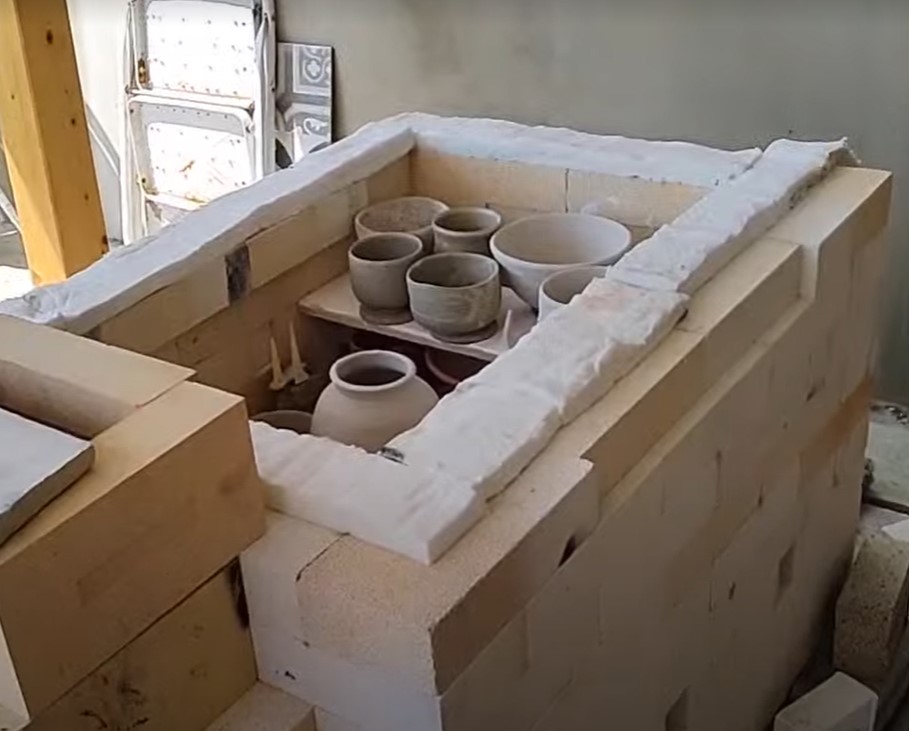
The state of the roof in November 2025. The fibre board has broken in many places and I can still just make a Frankenstein lid with fibre and bits of board for a double layer and side insulation. I think it will need replacing soon.
I have a post on the first firings here and another blog post looking at how my pottery firing CO2 emissions compare with taking a plane or running a car and it is surprisingly little.
Very happy with this kiln!
If you made it this far. Well done! Haha. Thanks for reading. I would be happy to read any comments you have on the build.
Like most potters, I am sure, I have had concerns about the emissions produced from firing clay work to over 1200° Celcius (>2192° F). I do sometimes wonder, is it even right to carry on when the world is overheating?
I use both an electric kiln of 300 litres and a fibre-and-brick-lined gas kiln I made myself of slightly less practical volume.
I have been making the assumption that the electric kiln would be less carbon producing, based on the fact that the power is produced by efficient industrial processes — versus my own clumsy attempts to fire in gas reduction. But I didn’t know that for a fact.
Today I had the urge to actually try and find some numbers to see what is the difference in emissions between the two types, and how does it compare to large consumer-based emission sources like aeroplane flights and car use. I chose transport as a frame of reference because it is something that most people engage in frequently is considered a ‘normal’ activity in society — rather than some other industry.
I did find some numbers online that give me a general idea of my emissions. Of course, they are based on statistical data and the electricity produced in Croatia may well be less or more efficient than in another country. But the comparisons are quite sound as a general guide, I think.
Gas firing
So, for a glaze firing in the gas kiln to around cone 8/1247°C/2277°F (an average of the top and bottom temps), I tend to use around 20 kg of butane (I know, it’s better to use propane but it’s hard to access where I live, and I manage despite freezing bottles sometimes). This number is not exact, but I know I roughly use two 10 kg bottles each firing.
According to calculations from this study article, complete burning of butane produces CO2 in a roughly 1:3 ratio (3.03 actually). So, theoretically my firing produces, around 60 kg (132.2 lb) in CO2 emissions (20 x 3).
Since I fire in a carbon-heavy reduction atmosphere from around 900°C/1652°F and up, which is incomplete burning, this CO2 number is slightly less, and some small amount of unburned butane will be emitted too. Plus a lot of water vapour which is produced as the butane molecules are split.
Electric firing
Over to the electric kiln: Carbonfund.org states that CO2 emissions from the production of 1 kWh of electricity come to around 0.3712 kg (0.857 lb) of CO2. This is for average US production but I imagine it is not too dissimilar over here in Croatia.
In a recent cone 7/1237°C/2259°F glaze firing of my electric kiln (packed with pots), I used 71.5 kWh of power (I do note down the meter readings). This equates to 26.54 kg(58.51 lb) of CO2 (71.5 x 0.3712).
So, yes, that is far less than the gas kiln, though I fire 1-2 cones cooler in the electric, and produces roughly a third of the emissions.
Flight emissions
But these numbers are small compared with plane flights, even on an individual share basis.
“CO2 emissions from aviation fuel are 3.15 grams per gram of fuel, which gives CO2 emissions from a Boeing 737-400 of 115 g per passenger per km. At a cruising speed of 780 km per hour [Wikipedia, 28.2. 08], this is equivalent to 90 kg [198.41 lb] CO2 per passenger per hour.”
So even my gas firing of 20-30 pots is only two thirds of 1 hour of cruising flight for one passenger. The electric is much less.
And if I, say, took a solo holiday trip of 4 hours each way, the CO2 for my share of the flight would be around 720 kg. In effect, I can fire the gas kiln 12 times and produce around the same CO2 as a trip on my own to, say, Istanbul, from Zagreb. The electric could be fired roughly 27 times to match the same flight! (More, actually, as I now fire to cone 6/1220°C/2228°F.)
It is worth noting that other organisations cited on the Carbon Independent page estimate the per hour/per passenger emissions much higher: from 134 – 350 kg CO2.
I only fire the gas kiln every 2-3 months, as I’m using the electric more these days.
And what about cars?
For another common frame of reference, we can look at cars. The US EPA says:
“A typical passenger vehicle emits about 4.6 metric tons of CO2 per year. This assumes the average gasoline vehicle on the road today has a fuel economy of about 22.2 miles per gallon and drives around 11,500 miles per year. Every gallon of gasoline burned creates about 8,887 grams of CO2”.
So, over a year, if I fire the gas kiln 7 times and the electric 12 times for glaze firings, I would produce 678 kg of CO2 approx. — way less than running an average US car: 4.6 metric tons equates to 4,600 kg of CO2.
In actual fact, it is more complex. My pots (as with most ceramics) are fired two times, with a low-fired 1,000°C/1832°F ‘bisque’ firing before glazing, then a glaze firing to top temp.
This bisque firing will produce around half the CO2 of a glaze firing to full temperature. So based on the 17 glaze firings, I should estimate my annual emissions at 678 kg (glaze) + 339 kg (bisque) = 1,017 kg. Still way less than a quarter of the emissions from running an auto for a year and less than one person’s share of a return 6-hour flight (remember, for a year’s-worth of firings).
My thoughts and plans
While any effort to reduce emissions is obviously beneficial for the planet, I think in context my level is very low, especially as a small (artistic) production business. My feeling, and that of most potters I think, is that our small contribution to emissions is worth it to have the joy of art in the world, and to have artists be able to make a living doing what they love.
There are so many other major, major, emitters of CO2 should be brought into the modern world and drastically cleaned up, like freight container ships and coal power plants, before we potters should be under pressure to make drastic changes. That’s not to mention the thousands of empty flights we have seen since Covid times. Or billionaires flying solo in the executive jets!
But potters are not without responsibility to try and improve the situation either.
I do intend to continue to develop beautiful glazes for the electric at cone 6 to minimize how often I need to fire with gas. To get certain glaze effects and colours I have to fire in reduction sometimes. I am working on reduction glazes that I can fire to lower temperatures too.
I am currently researching the cost and how-to of getting some solar panels. It looks like it would be quite easy to produce all the power for the electric kiln and more with panels I could put on my roof. My house faces south on one side and I get strong sun from dawn till dusk, so I think it could be a good solution.
Australian potter Steve Harrison has set up a system for this and I imagine it must be a great feeling to know your kiln is not emitting CO2 at all.
If all this reads like I am trying to persuade myself that it is all ok, that’s definitely true. I have been worried about my CO2 contribution. So, it is something of a relief to do the research and find that I am having quite a minimal environmental influence. Thanks, mathematics!
And I hope in the near future I can make my emissions far less, with a little expense, which is an investment in the planet as I see it.
Is it appropriate to compare pottery firing with flights and car use? What do you think about the dilemma of emissions vs producing ceramic art? Did I use any faulty logic? Leave me a comment below.






 Dan Palmer Ceramics